
 Tiếng Việt
For many SaaS founders, growth problems tend to trigger the same instinctive response: add another SaaS tool. Research shows that companies used an average of 106 different SaaS applications in 2024, highlighting how widespread tool proliferation has become.
- Pipeline visibility slipping? Add a CRM plugin.
- Marketing attribution unclear? Layer on analytics software.
- Team coordination slowing down? Introduce a new project management platform.
Each tool promises clarity, speed, and control. And for a moment, it feels like progress.
But over time, something subtle happens. Decisions take longer. Metrics stop aligning. Teams spend more time navigating systems than executing strategy. What once felt like momentum slowly turns into friction.
The uncomfortable truth is this: the next phase of SaaS growth isn’t unlocked by adding more tools. It’s unlocked by simplifying the systems underneath them.
The Illusion of Progress: When Tool Stacking Feels Like Control
Adding a new SaaS tool often creates the feeling that something is being fixed. There’s a dashboard to check, a workflow to automate, and a feature to configure. Activity increases, and with it, a sense of control.
But control and clarity are not the same thing.
Stacking can easily become growth theatre; motion without meaningful progress. Each new platform introduces its own logic, metrics, and workflows. The sheer volume of tools is staggering; at its peak, some companies were using 371 different SaaS applications across functions. In fact, nearly 49% of SaaS licenses go unused, meaning nearly half of these tools are paid for yet never truly adopted.
In many SaaS companies, the stack grows faster than the business itself. What starts as a practical solution becomes a tangled web of tools that no one fully owns and few fully trust.
The Hidden Cost of Context Switching Across Systems
The real cost of poor tech stack management rarely shows up on a budget line. It shows up in lost focus.
Teams jump between systems to answer simple questions. Recent research shows that knowledge workers use between 9 and 15 different apps per day, with some logging into more than 20 distinct tools, and this fragmentation directly impacts productivity. Revenue data lives in one place, usage data in another, marketing insights somewhere else entirely. Context switching becomes the default mode of work, fragmenting attention and slowing decision cycles.
As a result, insights arrive late—or not at all. Leadership discussions shift from “What should we do next?” to “Which number is correct?” Over time, this friction compounds, quietly limiting SaaS growth by slowing learning and execution.
The stack was meant to accelerate progress. Instead, it becomes a bottleneck.
When Your Stack Is Managing You (Not the Other Way Around)
Metrics no longer align across platforms. Teams duplicate work because systems don’t communicate. Accountability blurs as ownership becomes tied to tools rather than outcomes, and decisions slow as leaders spend time reconciling data instead of acting on it.
At this point, the SaaS tool stack is no longer supporting growth—it’s managing it. Fragmented stacks don’t just slow teams; they erode confidence in the data itself. Workflows begin to adapt to software limitations rather than strategic priorities, and instead of enabling clarity, the stack introduces noise.
This is where many founders feel stuck. They know something isn’t working, but adding yet another platform feels like the only available move—even when it’s the very thing deepening the problem.
From Tool Chaos to Clarity: A Smarter Approach to Tech Stack Management
Strong tech stack management isn’t about having the “best” tools. HubSpot’s research consistently points to the same conclusion: teams perform best when systems are integrated around shared data, clear workflows, and a single source of truth, rather than scattered across disconnected platforms. It’s about having the right system.
That requires stepping back from individual platforms and looking at how information flows through the business. Which decisions matter most? Which metrics truly guide growth? Which workflows create leverage—and which merely create activity?
When tools are chosen intentionally and designed to work together, they reduce friction instead of adding to it. Clarity replaces complexity. Teams spend less time managing systems and more time executing strategy.
This is where sustainable SaaS growth actually begins.
The Audit → Consolidate → Align Framework for Scalable Operations
At Novavi, we see simplification not as reduction, but as design. The goal isn’t to cut tools for the sake of minimalism, but to intentionally shape a system that supports how the business actually grows. When done well, simplification becomes a foundation for long-term scalable operations, not a short-term cleanup exercise.
Our approach focuses on three stages that move tech stack management from reactive maintenance to a strategic capability.
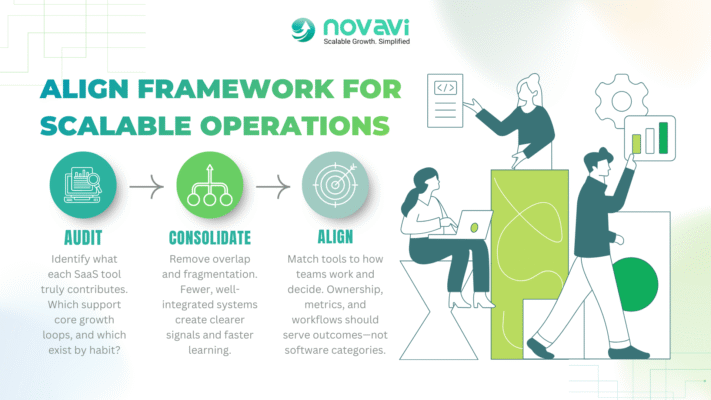
Together, these three stages transform tech stack management from a reactive task, constantly adding and patching, into a deliberate growth system. The result is not just a cleaner stack, but an operating model that supports clarity, confidence, and sustainable scale.
Why Simplification Is the Next Phase of SaaS Growth
Simplification doesn’t mean doing less. It means removing what slows you down.
When systems are clear, decisions move faster. Data becomes trustworthy. Teams operate with confidence rather than hesitation. Most importantly, scalable operations emerge naturally because the business isn’t fighting its own infrastructure.
Founders often underestimate how much growth potential is locked behind unnecessary complexity. The fastest-growing SaaS companies aren’t the ones with the most tools—they’re the ones with the cleanest systems.
Designing Growth Systems That Scale Cleanly
If your stack feels heavier than your growth, the answer isn’t another platform. It’s a better system.
At Novavi, we work alongside founders to redesign growth engines that prioritize clarity, alignment, and execution. By streamlining tech stack management and focusing on scalable operations, we help SaaS teams remove the noise that slows them down and build systems that support real, compounding SaaS growth.
Contact us to design the right SaaS tool stack for your growth, because growth isn’t about adding more.
It’s about designing better.
Further Readings:
Matleena S (2025) SaaS statistics for 2025: Market trends, growth insights, and key metrics
Slingerland C (2025) 50 Quick SaaS Statistics Every Business Should Know
Moore A (2025) The Hidden Cost of Context Switching: How Many Software Tools Tech Professionals Use Daily—and What It’s Costing Us
Kowalska K (2025) Customer service software for enterprises: Best options that scale with growth