
 Tiếng Việt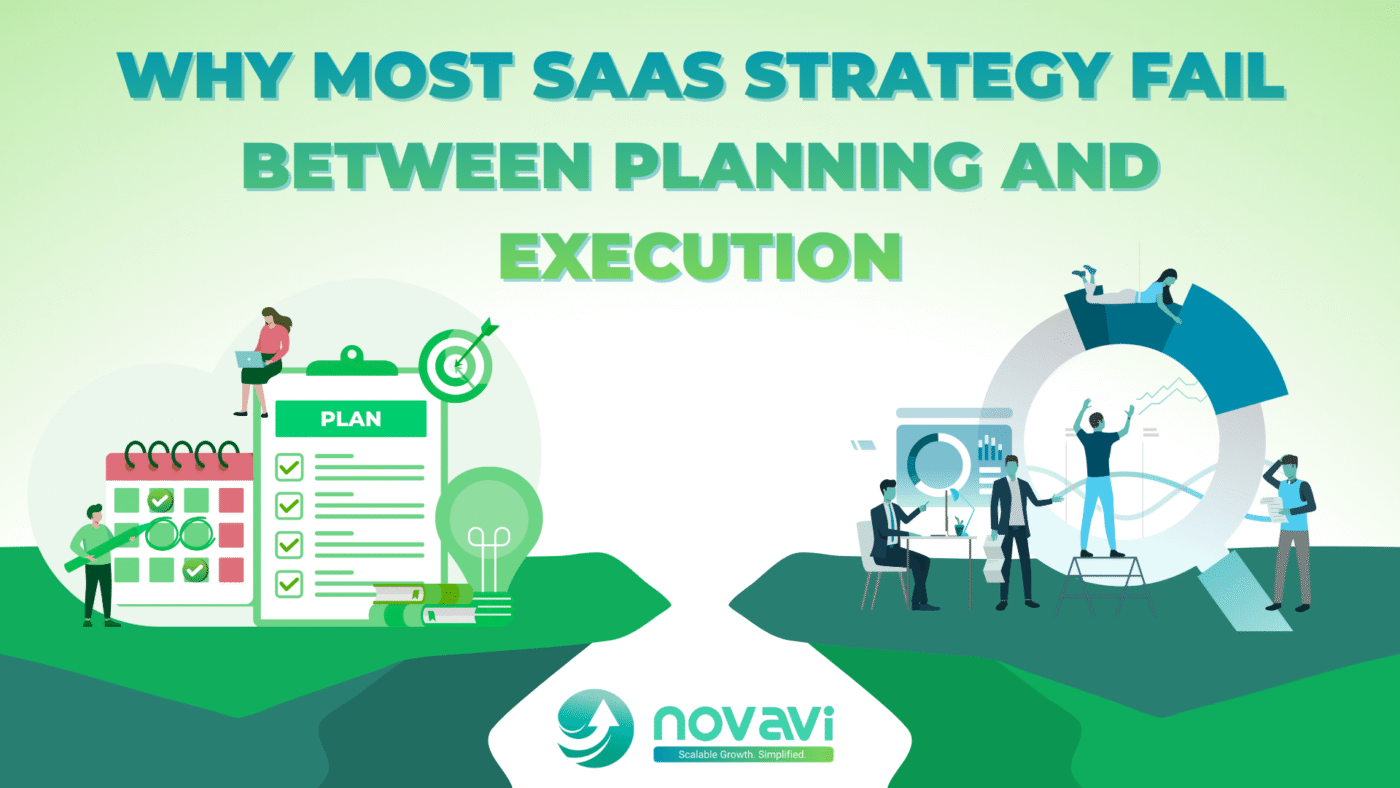
Most SaaS teams don’t fail because they lack ambition or intelligence. In fact, many SaaS strategies look impressive—well-researched, logically structured, and confidently presented in decks. In fact, research shows up to 90% of corporate strategies fail at execution, even when plans are solid.
The problem isn’t the SaaS strategy itself.
It’s what happens after the strategy is approved.
Growth breaks down in the space between planning and daily execution. This “system gap” is where vision loses momentum, accountability weakens, and strategy slowly turns into background noise. At Novavi, we see this pattern repeatedly: strong ideas without a system to carry them into action.
This article explores why that gap exists, where execution typically breaks, and how SaaS teams can close it by designing a system that connects strategy to execution, consistently and at scale.
The Strategy Illusion: When Planning Feels Like Progress
In SaaS, planning often feels productive because it looks productive. Strategy workshops, off-sites, and roadmaps create clarity—at least temporarily. Teams align around objectives, leadership feels confident, and the organization moves forward with a sense of direction.
But clarity on paper does not guarantee clarity in practice.
Many teams unknowingly fall into the strategy illusion: the belief that documenting a SaaS strategy is equivalent to operationalizing it. In fact, only about 5% of employees actually understand their organization’s strategy, meaning the vast majority never internalize what they’re supposed to deliver.
The reality is harsher. Strategy is static; execution is dynamic. Strategy captures intent at a moment in time, while execution requires continuous decision-making under changing conditions. Without a mechanism that translates intent into everyday choices, strategy remains aspirational rather than operational.
This is where strategy implementation quietly fails; not because teams disagree with the plan, but because nothing meaningfully changes in how work gets done on Monday morning. If priorities, workflows, and metrics stay the same, the strategy exists only as a narrative.
And that illusion sets the stage for deeper execution breakdowns.
Where Execution Breaks in SaaS Teams
Once strategy leaves the boardroom, execution begins to fracture in predictable ways. This isn’t a niche problem: studies show that up to 70–78% of strategic initiatives fail to achieve their intended outcomes, not because the ideas were bad, but because the system to implement them was weak.
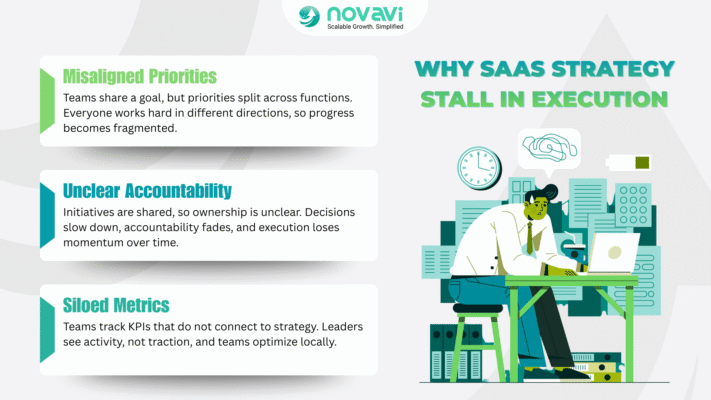
1. Misaligned Priorities
Most SaaS teams can articulate the top-line goal. The problem is that priorities fragment as they move down the organization. Product optimizes for delivery speed, marketing for pipeline volume, sales for short-term wins; each rational in isolation, but disconnected in aggregate.
Without a system that translates strategy into clear, shared trade-offs, teams interpret priorities locally. The result is motion without direction. Everyone is working hard, but not necessarily on the same problem.
This is the first crack between strategy to execution: the absence of a shared prioritization logic that governs daily decisions.
2. Unclear Accountability
Execution also breaks when ownership is vague. Strategic initiatives are often assigned to groups rather than individuals. Responsibility becomes shared, which in practice means diluted.
When no one truly owns an outcome, decisions slow down. Risks are avoided. Progress depends on consensus rather than clarity. Over time, execution energy drains; not because teams don’t care, but because the system doesn’t empower decisive action.
Strong strategy implementation requires explicit ownership, not just broad alignment.
3. Siloed Metrics
Finally, execution collapses when measurement reinforces silos. Teams track KPIs that make sense within their function but fail to connect to the broader strategy. Progress is reported, but not integrated.
Leadership sees activity, not traction. Teams optimize locally, not systemically. Metrics explain the past rather than guide the next decision.
At Novavi, we rarely see execution fail due to lack of data. It fails because data is not designed to support strategy to execution across teams.
These breakdowns are not behavioral flaws. They are system design flaws—and systems can be redesigned.
Closing the System Gap: A 3-Step Execution System
Bridging the gap between strategy and execution does not require more process. It requires better structure. High-performing SaaS organizations design systems that consistently translate intent into action.
Based on what we see across growth-stage SaaS teams, closing the system gap comes down to three connected steps.
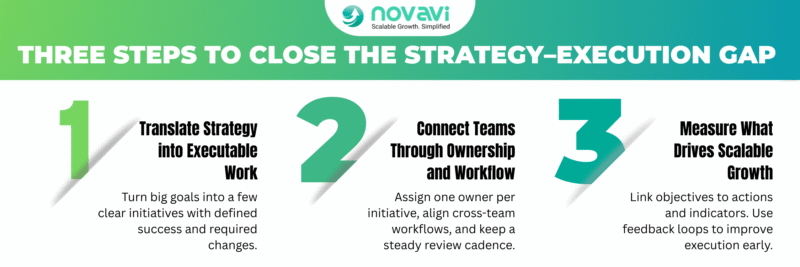
Step 1: Translate Strategy into Executable Work
Every SaaS strategy begins as an aspiration: grow faster, expand markets, improve retention. Execution begins when those aspirations are converted into decision-ready initiatives.
This step is not about creating more plans. It is about reducing ambiguity. Each strategic objective must be broken into a small number of initiatives that answer three questions clearly:
- Why this now?
- What does success look like?
- What work must change to get there?
Without this translation, teams default to familiar activities rather than strategic ones. Strategy implementation becomes symbolic instead of operational.
Step 2: Connect Teams Through Ownership and Workflow
Once initiatives are clear, execution depends on connection. Strategy does not fail because teams are siloed by nature; it fails because workflows are not designed to cross boundaries.
Each initiative requires a single owner with clear decision rights. Supporting teams must understand how their work contributes, when coordination is required, and how progress is reviewed. This is where strategy to execution becomes tangible.
Connection also requires rhythm. Weekly execution reviews, monthly recalibration, and quarterly realignment ensure that strategy stays alive as conditions change. Without cadence, execution becomes reactive. With cadence, it becomes deliberate.
This step turns plans into daily action, not by adding bureaucracy, but by making execution visible and coordinated.
Step 3: Measure What Drives Scalable Growth
Measurement is where systems either reinforce strategy or undermine it. To support scalable growth, metrics must form a chain—from strategic objectives to leading indicators to team-level actions.
Instead of isolated KPIs, teams need connected measures that answer a simple question: are today’s actions moving the system in the right direction?
When measurement is designed well, it creates feedback loops. Teams see bottlenecks earlier. Decisions improve faster. Strategy implementation becomes adaptive rather than rigid.
This is how execution compounds over time, not through heroics, but through learning systems.
What a Real Growth Engine Looks Like
When these three steps work together, something fundamental changes. Strategy stops being an event and becomes an operating principle. McKinsey research shows that companies with strong decision-making and execution systems are more than twice as likely to outperform their peers, underscoring why growth depends on how strategy is operationalized, not how well it is articulated.
Without a system, a SaaS strategy is reviewed quarterly, interpreted differently by each team, and evaluated through lagging results. Growth depends heavily on individual effort and leadership intervention.
With a system, strategy guides weekly decisions. Teams execute with shared priorities and clear ownership. Metrics surface signals early enough to adjust. This is what a real growth engine looks like—not a campaign, not a framework, but a repeatable system that enables scalable growth.
At Novavi, we think of growth engines as connective infrastructure. They don’t replace strategy; they allow strategy to function in reality.
Strategy Doesn’t Fail. Systems Do.
Most SaaS leaders don’t need better ideas. They need better systems.
When execution stalls, the instinct is often to revise the strategy. In reality, the failure usually sits between strategy and operations. The system gap—not the strategy itself—is what limits progress.
Closing that gap requires intentional design: translating intent into executable work, connecting teams through ownership and workflow, and measuring what truly drives outcomes. When those elements align, SaaS strategy stops being aspirational and starts becoming operational.
If your strategy makes sense but execution feels fragmented, the issue is not effort or alignment—it’s structure. And structure can be built.
At Novavi, we help SaaS teams close the system gap and turn strategy implementation into measurable, scalable growth.
Further Readings:
Lasa N A, Pedroni A, Komm A, and Lavallée (2024) In the spotlight: Performance management that puts people first
Miyake D (2025) The Strategic Imperative: Your Complete Guide to Strategy Planning Software
Kraaijenbrink J (2021) The Biggest Unsolved Problem In Strategy Execution And What To Do About It