
 Tiếng Việt
AI adoption dominates every SaaS conversation, promising faster growth, smarter decisions, and limitless scale. Yet as 2026 approaches, results remain uneven.
An MIT report found that 95% of AI pilots fail to achieve measurable growth, even though more than 80% of companies have implemented at least one AI tool. McKinsey’s 2024 findings echo this: two-thirds of AI initiatives fail to create lasting business impact.
Why? Because most “AI transformations” were treated as shortcuts, not systems.
The truth is simple: AI magnifies design, not intent.
It doesn’t replace clarity; it scales the quality of it. Without a coherent automation strategy, adoption accelerates inefficiency instead of intelligence. The SaaS founders and teams turning AI into a true advantage are those who treat it as an amplifier of structure, not a substitute for strategy.
For SaaS SMEs and scale-ups, this distinction is vital. Smaller teams don’t have the luxury of waste; every process, data point, and workflow must serve a clear purpose. In these companies, AI adoption becomes a system test that reveals how well (or poorly) their operations actually work.
The Reality Check: Why 95% of AI “Innovations” Don’t Move the Growth Needle
AI adoption has exploded across the SaaS landscape, but measurable impact hasn’t followed. Too often, teams deploy tools faster than they can integrate them. Marketing automates outreach before refining positioning. Sales plug in AI scoring systems without revisiting qualification logic or pipeline discipline.
The issue isn’t capability; it’s coherence.
Growth doesn’t come from code; it comes from alignment. Without synchronization between technology, process, and purpose, even the most advanced systems hit their AI limitations early.
For SaaS SMEs, this problem compounds. Fragmented data, siloed apps, and unclear workflows make it nearly impossible for automation to deliver meaningful outcomes.
The lesson is clear: without a deliberate automation strategy, AI becomes another layer of noise instead of acceleration. It can optimize how you work, but it cannot decide what truly matters or why your funnel leaks.
AI isn’t dangerous because it’s wrong; it’s dangerous because it’s distracting.
Strategic founders don’t ask, “What else can we automate?” They ask, “What are we automating for?”
The Amplification Effect: How AI Exposes — and Sometimes Corrects — Strategic Weaknesses
When systems lack structure, AI doesn’t fix the problem; it magnifies it.
Automated workflows replicate broken assumptions faster. Predictive models reinforce flawed data. “Personalization engines” send the wrong message to the right audience, but now at scale.
According to the PEX Report 2025/26, data quality and availability remain the top challenges in AI adoption, while only a third (34%) of respondents say their AI initiatives align fully with business goals. Technology isn’t the limitation; strategy and system design are.
But it’s not entirely true that AI only amplifies chaos. When designed with feedback loops and adaptive learning, it can also surface clarity, uncovering inefficiencies, patterns, and opportunities humans miss.
In this sense, AI acts as both a mirror and a modifier: it reflects the discipline of your system while revealing where it can evolve.
The strongest SaaS leaders, especially in small and mid-size companies, understand this duality. AI’s real value doesn’t come from code, but from how it’s integrated into a coherent SaaS growth strategy. When the structure is sound, with precise positioning, connected processes, and reliable data, AI amplifies performance. When it’s weak, AI exposes the cracks faster than ever.
The difference isn’t in the tool; it’s in the architecture, feedback culture, and decision rhythm that define how AI lives within your business. Strategic founders don’t chase hype; they design adaptive systems that evolve intelligently with it.
The Real Growth Levers Hidden Behind the Hype
The SaaS companies winning with AI in 2026 aren’t the loudest; they’re the most disciplined. They understand that AI adoption isn’t about replacing people; it’s about refining how people make better decisions.
In these teams, AI acts as a signal amplifier, not a strategist. It helps humans see further, decide faster, and adapt smarter.
They use AI to:
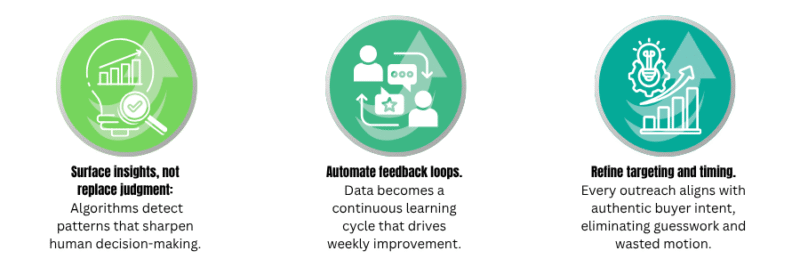
The difference isn’t in using more AI; it’s in using it more intelligently.
For successful SaaS SMEs, growth happens when automation enhances clarity and strategy drives the system, not the other way around. AI isn’t the finish line; it’s the feedback loop. The shift is subtle but powerful: from “AI for speed” to “AI for learning.”
Action Plan: Refocus Before You Automate
For many growing SaaS SMEs, AI adoption feels like the natural next step. New tools promise to streamline workflows, boost sales, and make lean teams feel enterprise-ready. But before investing in another platform, founders and operators should pause and ask three grounding questions:
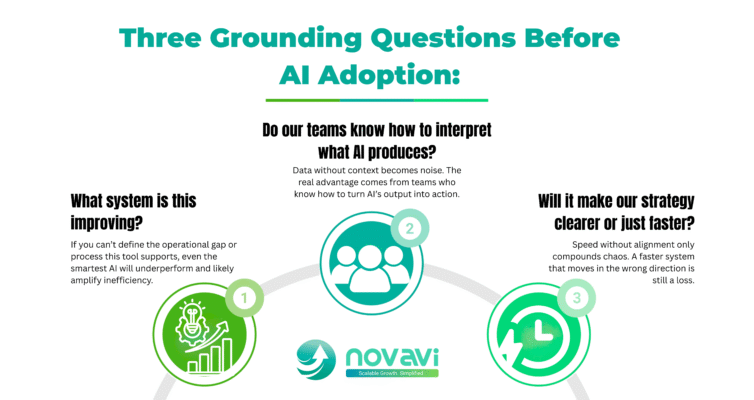
For SaaS SMEs, these aren’t theoretical questions; they define whether AI becomes a multiplier or a money sink. Unlike large enterprises, smaller teams can’t afford messy automation; every workflow and dataset must be purposeful.
AI will continue reshaping SaaS through 2026, but it will reward those who adopt it intentionally. Sustainable growth still depends on human design — the ability to connect insight, intent, and execution into one cohesive, adaptive automation strategy.
When clarity leads automation, even small SaaS teams can scale smarter than giants chasing hype.
The Final Reflection
The wave of AI adoption isn’t slowing down, but clarity remains the rarest advantage.
If your initiatives sit somewhere between potential and noise, it’s time to pause, reassess, and rebuild around purpose.
Contact us to evaluate whether your automation strategy is truly accelerating growth or quietly adding friction disguised as progress.
Together, we’ll help you shape a smarter, more sustainable SaaS growth system — one that learns, adapts, and lasts.
Further Readings
Aidataanalytics Network (2025) Data quality and availability top list of AI adoption barriers
Fortune (2025) MIT report: 95 percent of generative AI pilots at companies failing
McKinsey & Company (2024) Upgrading software business models to thrive in the AI era
Ratiotech (2025) SaaS growth strategy: 7 innovative approaches and common pitfalls to avoid for your B2B SaaS
SaaS Capital (2025) AI adoption among private SaaS companies and its impacts on spending and profitability
Stellaxius (2025) 5 key factors for a successful AI implementation