
 Tiếng Việt
The irony of progress is this: the smarter the founder, the harder it becomes to see what’s blocking growth. Many startup founders build their companies on intellect, instinct, and relentless drive — but even the most capable minds can fall into invisible traps.
SaaS growth rarely fails because of a lack of effort, up to 90 % of startups fail, only about 1 in 10 survive long-term. It falters because of blind spots — the repetitive patterns that go unnoticed while founders push forward. These blind spots don’t signal incompetence; they’re proof of complexity. When your business evolves faster than your systems or mindset, vision narrows, and small inefficiencies compound.
At Novavi, we study these invisible patterns not to judge but to help startup founders see more clearly. Think of us as your growth mirror: we help reveal the unseen habits that stall progress and the systemic fixes that reignite momentum.
This article uncovers five recurring SaaS growth blind spots and how to identify them early, before they quietly slow your trajectory.
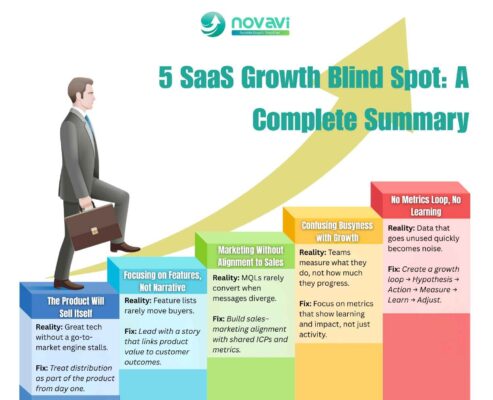
Blind Spot 1: “The Product Will Sell Itself”
It’s one of the most common myths in SaaS: that a great product automatically drives SaaS growth. Many startup founders assume achieving product-market fit is the finish line, when in reality, it’s just the starting gate.
Product-market fit validates that your product solves a problem people care about — but it doesn’t guarantee demand. Too often, founders over-index on refining features and under-invest in go-to-market strategy. They wait for referrals, organic buzz, or inbound magic that never scales.
We’ve seen startups with brilliant technology but no predictable demand rhythm. Their product-market fit exists on paper, but without intentional distribution, growth becomes inconsistent.
The fix: treat distribution as part of the product. Build your growth engine as early as your codebase — investing in content systems, sales enablement, and outbound signals. When you consider product-market fit as both solution and system, you build momentum that doesn’t depend on luck.
Blind Spot 2: Focusing on Features, Not Narrative
Features show what you built; narrative shows why it matters. Many startup founders fall into the habit of selling logic when buyers respond to meaning. Technical specs and capability lists rarely capture attention — stories do.
This is a subtle but significant barrier to SaaS growth. Founders become fluent in product detail but forget to translate value into customer language. They build decks that describe “how” but never anchor the “why.” The result? Pitches that impress but don’t convert.
The fix: build a brand story, not a feature sheet. Connect your value proposition to outcomes that customers feel — time saved, risk avoided, confidence gained. As your story strengthens, clarity compounds internally too.
A quick diagnostic cue: if your audience needs a demo to “get it,” your narrative isn’t yet clear enough to sell itself.
Blind Spot 3: Marketing Without Alignment to Sales
Marketing generates interest; sales converts it. Yet most SaaS teams operate in silos, each optimizing for different goals. The result is predictable: MQLs that don’t turn into revenue, campaigns that promise one thing while sales conversations deliver another.
Lack of sales marketing alignment is one of the most damaging — and overlooked — threats to SaaS growth. When marketing focuses on awareness while sales chases short-term quotas, the customer experience fractures. Each team believes it’s performing, but the system as a whole underperforms.
The fix: create a shared funnel language. Align ICPs, lead scoring, and messaging across both functions. When sales marketing alignment becomes a daily discipline — not an occasional workshop — friction fades and feedback tightens.
A practical cue: if marketing says “leads are great” while sales says “they’re not ready,” alignment is broken. True growth happens when both functions own the same success metrics and narrative. Companies with aligned sales and marketing functions achieved 24 % faster revenue growth and 27 % quicker profit growth over three years.
In our experience at Novavi, restoring sales marketing alignment can unlock months of lost momentum within weeks.
Blind Spot 4: Confusing Busyness with Growth
High activity doesn’t equal high impact. Many teams confuse motion for momentum, celebrating packed calendars and overflowing task boards as progress. But in SaaS, growth depends less on volume and more on learning velocity.
According to McKinsey, more than 90% of software companies with over $500 million in revenue still fall below a growth-efficiency ratio of 1 — spending more to grow than they gain in recurring revenue. Even at scale, the illusion of productivity often hides structural inefficiency.
When startup founders measure success by output, they risk rewarding busyness over clarity. Dashboards full of vanity data can mask weak performance metrics — indicators that show what’s moving, not whether it’s working.
To achieve sustainable growth, audit for leverage points. Ask: which actions compound results, and which simply consume time? Focus your teams on experiments that produce insight, not just completion.
Diagnostic cue: if your dashboards track volume instead of velocity — how fast you learn per cycle — you’re likely busy, not growing. The best founders trade intensity for intentionality.
Blind Spot 5: No Metrics Loop — No Learning
Without a feedback loop, growth turns into guessing. Many companies collect performance metrics but fail to translate them into new behavior. Reports are shared, conclusions are drawn — yet nothing changes.
Real SaaS growth depends on continuous learning. The most resilient systems operate on a simple loop: Hypothesis → Action → Measure → Learn → Adjust. Without it, every initiative restarts from zero.
We often see teams treating metrics as static dashboards rather than living guides. A report that doesn’t influence decisions is wasted data. The fix: turn reviews into learning sessions. Replace passive reporting with active iteration.
If your team’s monthly reviews feel like recaps instead of recalibrations, your loop is broken. Rebuilding it may be the single most powerful way to regain momentum and confidence
How to Spot These Early — The Founder’s Diagnostic Checklist
Even the most capable founders can’t fix what they can’t see. To sustain SaaS growth, it’s critical to pause and examine where clarity might be slipping. Here’s a quick self-audit to reveal hidden friction before it compounds:
- Do you know your biggest constraint to growth, or are you optimizing everything except the bottleneck?
- Are marketing and sales sharing the same story, or is sales marketing alignment still a recurring tension?
- Do your performance metrics lead to real actions, or do they sit idle in dashboards?
- Is your product-market fit translating into steady, repeatable demand?
- Are you measuring learning speed, not just output volume?
The earlier you detect these blind spots, the faster you’ll scale without friction. Founders who diagnose consistently don’t chase noise — they compound insight. Because in the long game of SaaS growth, clarity is the ultimate accelerator.
8. Reflect and Reframe
Every founder has blind spots — even the most strategic, disciplined ones. The real differentiator isn’t avoiding them, but seeing them early enough to steer with intention.
At Novavi, we don’t just design growth systems; we design clarity. Our role as a strategic growth partner is to help startup founders uncover what’s hidden in plain sight — aligning vision, teams, and performance metrics to create sustainable, compounding SaaS growth.
So pause for a moment and ask yourself: Which blind spot feels most familiar in your business? Awareness is the first act of leadership — and the starting point of renewal.
If you’re ready to diagnose what’s really holding back your next stage of SaaS growth, we’re here to help you see further, act faster.
Contact us to grow with confidence.
Further Readings:
Howarth J (2025) Startup Failure Rate Statistics (2025)
McKinsey & Company (2024) How efficient growth can fuel enduring value creation in software
Kennedy K (2024) Why Businesses Should Work Harder To Sync Marketing And Sales
Zuercher M (2024) The Era of Unchecked SaaS Growth Is Over.
Grant D (2024) Data-Driven Growth: Accelerating SaaS Sales In The Era Of Data.
Kolluru P (2024) 8 Reasons SaaS Startups Fail — And How To Overcome Them.
Klotins, E., Unterkalmsteiner, M., Gorschek, T. (2023) Software Engineering Knowledge Areas in Startup Companies: A Mapping Study.