
 Tiếng Việt
Every week, founders and teams publish new claims about speed, scale, automation, intelligence, and transformation. AI has made it even easier to produce polished messaging at volume. Homepages sound sharper. LinkedIn posts sound smarter. Sales decks look cleaner. But for buyers, none of that necessarily creates confidence. In fact, it often creates the opposite.
Today’s B2B buyers are not struggling with a lack of options. They are struggling with a lack of belief. They have seen too many overpromises, too many recycled claims, and too many brands saying roughly the same thing in slightly different language. That is why trust building has become one of the hardest and most important challenges in SaaS growth.
Buyers no longer believe what brands say just because it sounds good. They believe what brands can prove.
That shift is visible in buyer behavior: HubSpot’s 2024 survey found that 75% of B2B buyers prefer to gather product information on their own, and 57% bought a tool in the last year without ever meeting the vendor’s sales team. Gartner’s more recent survey goes even further, finding that 67% of B2B buyers prefer a rep-free experience.
In this environment, trust is no longer a soft brand outcome. It is a measurable growth asset. The companies that win will not be the ones with the most polished positioning. They will be the ones who treat trust building as a system; something earned through evidence, reinforced through consistency, and accelerated through credibility.
The Trust Deficit: Why Buyers Are Tuning Out Marketing Language
There was a time when good messaging alone could move the market.
That filtering is not irrational. It is a response to risk. G2’s 2024 Buyer Behavior Report shows that 81% of software buyers consider a vendor’s history with security breaches, and 31% consult review sites more often than any other source. When buyers are actively checking security history and outside validation, it is clear they are not taking brand claims at face value. They are looking for signals that stand up under pressure.
This is the trust deficit shaping modern SaaS.
When every company says it is smarter, faster, easier, or more transformative, the words start to lose meaning. The issue is not that buyers hate marketing. It is that they have become highly sensitive to vagueness. Generic messaging feels like a risk. Inflated language feels like distance. And anything that sounds too polished without evidence can trigger doubt instead of momentum. That is why trust building cannot rely on persuasion alone anymore.
If your positioning sounds impressive but your proof is weak, buyers notice. If your content promises outcomes but your case studies are thin, buyers notice. If your team speaks with confidence but your data lacks specificity, buyers notice. What used to be “good enough” brand communication now feels incomplete.
In a skeptical market, credibility is built through precision.
The brands that stand out are not necessarily the loudest. They are the clearest. They reduce ambiguity. They name the problem they solve. They explain how they solve it. They make their claims easier to believe because they remove the need for blind trust.
That is where trust building begins: not by sounding more convincing, but by becoming harder to doubt.
Proof Over Promise: Why Evidence Now Outperforms Positioning
In a market crowded with promises, proof becomes the advantage. Buyers want to know what happened, for whom, under what conditions, and with what result. They want specifics. They want implementation details. 31% of buyers consult review sites more often than other sources, which is a strong signal that third-party validation is now a mainstream part of software evaluation, not a nice-to-have.
A testimonial is not just a nice addition. It is a confidence shortcut.
A case study is not just content. It is evidence that your promise has survived contact with reality.
A customer quote, usage metric, benchmark, founder insight, or behind-the-scenes explanation can all act as a trust signal. These signals matter because they reduce the interpretive burden on the buyer. Instead of asking them to believe your message on its own, you give them something concrete to evaluate.
This is where many brands get it wrong. They spend too much time polishing the promise and not enough time structuring the proof.
They refine taglines, elevate tone, and sharpen visual identity, all useful moves. But if the buyer still cannot answer basic questions like “Why should I believe this?” or “Where is the evidence?”, then the message breaks. Not because it lacks style, but because it lacks support.
In a skeptical SaaS market, trust building depends on visible proof.
That proof can take many forms:
customer outcomes, founder expertise, implementation transparency, benchmark data, testimonials, specific use cases, product walkthroughs, and honest explanations of limitations. Together, these become the infrastructure of credibility.
The strongest brands understand that social proof is not decoration. It is conversion support, and the strongest founders understand that a well-placed trust signal can outperform an entire page of polished messaging.
The Empathy Edge: Why Buyer Doubt Is Actually Strategic
It is easy to frame skepticism as a problem, but smart companies treat it as information.
When buyers hesitate, they are usually not being difficult. They are trying to manage risk. They are asking, often silently: Is this real? Is this relevant? Can I defend this decision internally? Will this create more problems than it solves?
That is why empathy is a strategic advantage in trust building.
When you understand buyer doubt, you stop trying to “push through objections” with louder messaging. Instead, you begin to identify what the buyer still needs in order to move forward. Maybe they need more specific outcomes. Maybe they need clearer onboarding expectations. Maybe they need stronger social proof from a similar company profile. Maybe they need a more visible trust signal earlier in the journey.
Gartner adds another important dimension here: 73% of B2B buyers actively avoid suppliers who send irrelevant outreach. That means misunderstanding buyer concerns does not just reduce effectiveness; it can actively erode trust.
Skepticism reveals where your credibility is still incomplete.
This is what makes a trust based growth strategy different from a persuasion-led one. A persuasion-led strategy asks: how do we make the message more compelling? A trust based strategy asks: what is the buyer missing that would make belief easier?. That shift matters.
Because when you treat doubt as a diagnostic tool, you uncover gaps that improve not just messaging, but performance. You write better landing pages. You create stronger case studies. You align sales conversations with actual buyer concerns. You reduce friction in the funnel because your content answers the questions buyers were already holding back.
In other words, empathy is not softness. It is signal detection, and in the current market, better trust building often starts by respecting buyer skepticism instead of resisting it.
A Simple Framework for Trust Building: Clarity, Consistency, Credibility
If trust is now one of the hardest currencies in SaaS, then founders need a more operational way to earn it.
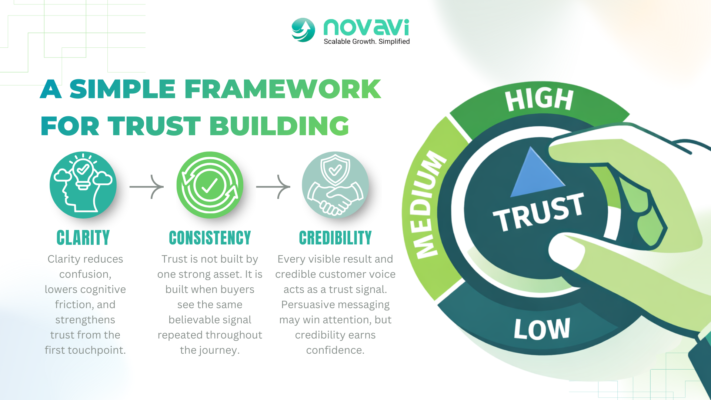
A useful framework is this: clarity, consistency, credibility.
1. Clarity
Clarity is the first layer of trust building.
If your message is vague, crowded with jargon, or inflated with language that sounds impressive but explains little, trust weakens before the conversation even begins. Clear brands are easier to evaluate. They define what they do, who it is for, what changes after adoption, and what evidence supports the claim.
Clarity lowers cognitive friction. It helps buyers understand the offer without needing to decode it. And every time you remove confusion, you strengthen a trust signal.
2. Consistency
Consistency is what prevents trust from collapsing across touchpoints.
McKinsey’s research shows buyers now move across ten channels on average, and more than half want a seamless omnichannel experience. A buyer may first encounter your brand through a founder post, then visit your homepage, then read a case study, then speak to sales. If the message shifts too much across those moments, credibility weakens. One page sounds bold, another sounds generic, and another makes claims that feel disconnected from the product reality.
That inconsistency creates doubt. Strong trust building requires alignment. Your positioning, proof, outbound messaging, customer stories, and sales narrative should reinforce the same core truth. Not with robotic repetition, but with shared precision.
This is where a trust-based system matters. Trust is not created by one strong asset. It is created when the buyer sees the same believable signal repeated across the journey.
3. Credibility
Credibility is where trust becomes durable.
This is where the proof shows up: the case studies, the metrics, the testimonials, the implementation logic, the founder’s point of view, the evidence behind outcomes. This is also where social proof becomes most powerful. Buyers want to know that others like them took the step and saw real value.
Every visible result, every credible customer voice, every concrete benchmark acts as a trust signal, and when those signals are structured well, they create momentum.
This is what separates persuasive messaging from believable growth infrastructure. One tries to win attention. The other earns confidence.
Trust Building Should Be Measured Like a Growth Asset
Many brands treat trust as intangible.
But if trust affects conversion quality, sales velocity, response rates, buyer confidence, and close probability, then it is not abstract. It is operational.
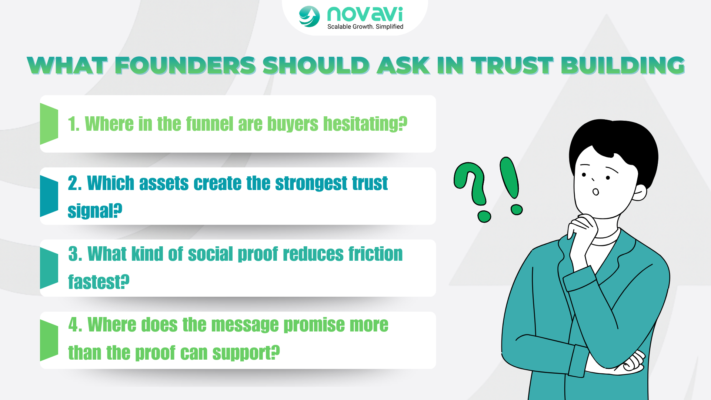
These are growth questions, not just brand questions.
A mature trust-based strategy treats trust like something you can strengthen deliberately. It audits gaps between the message and the evidence. It identifies where proof should appear earlier. It ensures that a visible, credible source backs every major claim.
That is how trust building becomes scalable.
Not through louder persuasion, but through better alignment between what you say and what buyers can verify.
In SaaS, Trust Is No Longer a Brand Layer — It Is the System
The age of buyer skepticism is not a passing phase. It is the new operating environment.
Buyers are more cautious because they have learned to be. They have seen too many polished brands making easy promises in a market where real results are harder to prove. As a result, trust building has become one of the hardest currencies in SaaS, and one of the most valuable.
Buyer skepticism is here to stay. In today’s SaaS market, trust is earned through clarity, consistency, and proof.
Contact Novavi to build a trust-based growth system where every message is backed by credibility.
Further Readings
Welch M (2024) B2B Buyers: The Latest Stats Salespeople Must Know [+HubSpot Data]
Gartner (2025) Gartner Sales Survey Finds 61% of B2B Buyers Prefer a Rep-Free Buying Experience
G2 Research (2024) Proving Value in the Age of AI
McKinsey & Company (2024) Five fundamental truths: How B2B winners keep growing