
 Tiếng Việt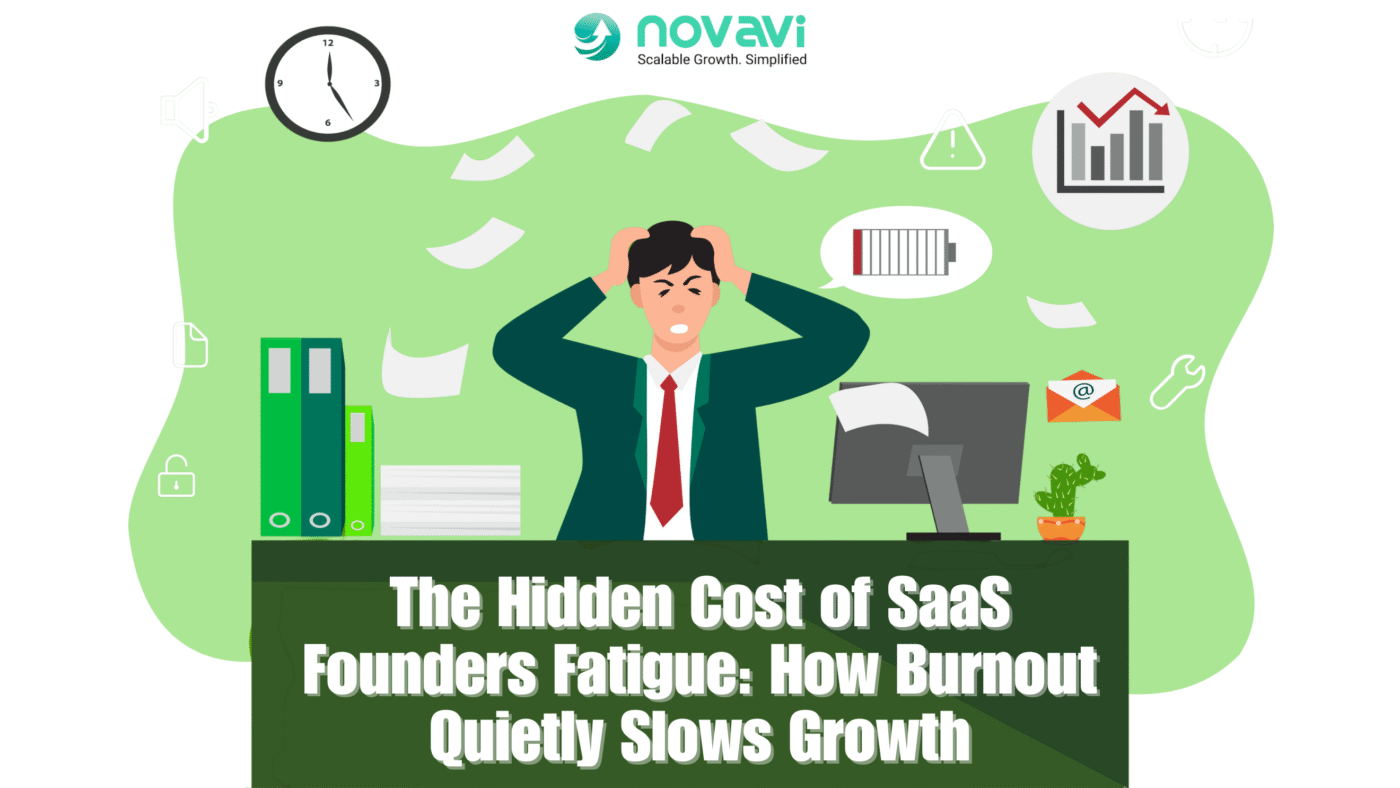
Why Founder Exhaustion Quietly Slows SaaS Growth
At 1:37 AM, a founder sits in front of a glowing dashboard, tweaking campaigns and refreshing metrics, hoping one more adjustment will unlock momentum. It is a familiar pattern for many SaaS founders, yet despite the effort, nothing moves.
The real issue is rarely the funnel. Growth often stalls because the person making the decisions is exhausted. Forbes reports that 72% of entrepreneurs experience significant mental exhaustion, often triggered by the same slow, cumulative work stress that builds during long days and late nights. Burnout is not just low energy; it reshapes how leaders think. Under sustained cognitive fatigue, decisions shift from strategic to reactive, and the company feels busy but directionless.
Fatigue distorts priorities. Distorted priorities create short-term fixes. Short-term fixes eventually appear as churn.
At Novavi, we see this often: sustainable growth depends not only on strong systems but on leaders who have the clarity and capacity to think deliberately.
How Exhaustion Distorts Priorities
From strategic CEO to firefighting operator
Exhaustion gradually pushes founders out of strategic leadership and into constant firefighting. Days revolve around context switching, Slack pings, escalations, and quick decisions made to survive the moment. The long-term question of “Where are we going?” turns into “What do I put out today?” Over time, urgency replaces intention and strategic focus fades.
Distorted judgment under fatigue
Sustained cognitive fatigue can reduce decision accuracy by as much as 40%, which explains why high-leverage work like pricing and ICP definition gets postponed when founders are overwhelmed. Founders respond to email, social posts, or ad tweaks instead of tackling pricing, positioning, or ICP clarity. Activity begins to feel like progress, even when the strategy is drifting. The team is busy, yet real momentum stalls.
What founders often miss
The danger lies in the accumulation of tired decisions: rushed roadmap changes, muddled messaging, reactive feature requests, and inconsistent leadership signals. McKinsey finds that 65% of startup failures stem from leadership, culture, and operational issues rather than product performance. Many of these issues emerge when tired decisions accumulate over time.
The Ripple Effect: Fatigue → Short-Termism → Churn
When a founder is exhausted, growth rarely collapses suddenly. Companies with aligned, clear-headed leadership outperform peers by two to three times in long-term growth, highlighting how much fatigue undermines strategic alignment.
Short-term fixes that backfire
Discounts become the default way to “hit the month.” Messaging gets stretched, creating misaligned onboarding expectations. Outbound volume increases, but without a refined ICP or narrative, the team simply chases noise. These choices feel productive in the moment but weaken long-term traction.
Internal ripple effects
Inside the business, shifting priorities create confusion. Sales and marketing chase different customer profiles. Product decisions follow loud voices instead of strategy. Alignment breaks, and the organisation mirrors the founder’s reactive state rather than their intended direction.
External ripple effects: churn and weak reputation
Mis-sold customers activate slowly, need more support, and churn quickly. Prospects notice inconsistencies between what was promised and what they receive. Referrals drop because the experience lacks reliability. What looks like a funnel issue often traces back to long-standing work stress and accumulated decisions made under cognitive fatigue.
The damage is subtle, but it reshapes the customer journey and the overall growth trajectory.
Rest as a Leadership Strategy
Reframing rest as a growth asset
Rest is not a reward for finishing the work; it is a prerequisite for sharp thinking. Research summarised by The Guardian shows that rest can improve problem-solving by up to 60%, underscoring why reflection and recovery enable sharper strategic choices. The most valuable leadership work requires intention, not volume, which is why rest functions as a genuine asset for growth.
What changes when a founder is rested
A rested founder sees the business with more precision. Saying no becomes easier. Experiments become thoughtful instead of rushed. Culture shifts as the team mirrors clarity rather than pressure. This is the foundation of real burnout recovery and a return to decisive, focused leadership.
Micro-practices that support better decisions
Impact does not require dramatic life changes. A weekly “CEO hour” dedicated to thinking instead of doing creates space for strategic reflection. A quiet review of core metrics filters signal from noise. Regularly deciding what to stop doing is as important as planning new initiatives. These habits foster better decision-making and support ongoing recovery from burnout.
Founder Reflection Checklist: Energy, Focus, Delegation
The simplest way for SaaS founders to regain clarity is to pause and ask direct questions. This quick self-audit reveals where attention is lost to habit or quiet work stress, and where it can shift back to high-leverage leadership.
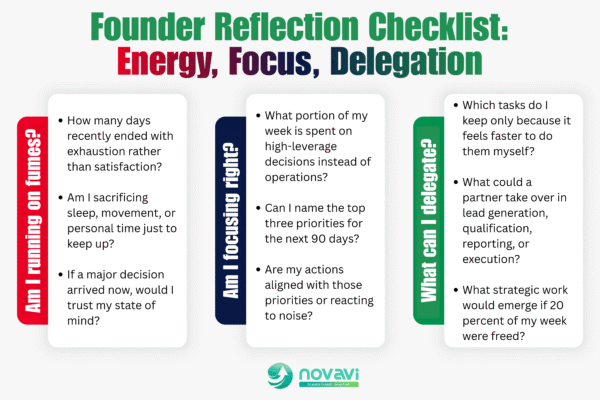
This is where strategic partners matter. Novavi helps lift the operational load so founders can regain energy, clarity, and direction.
Reset Before Fatigue Starts Taxing Your Growth
If you see yourself in any of this, it does not mean you are falling behind. It means you have been carrying too much for too long. Growth requires clarity, not exhaustion.
Novavi helps rebuild that clarity. As your strategic growth partner, we take on the heavy operational work of lead generation, qualification, system building, and pipeline structure. You regain the space to lead with intention while we help the engine run with consistency and discipline.
Further Readings
Dan Murray-Serter (2020) Why Entrepreneurs Need To Talk About Their Mental Health
https://www.mckinsey.com/capabilities/people-and-organizational-performance/our-insights/scaling-up-how-founder-ceos-and-teams-can-go-beyond-aspiration-to-ascent
Aaron De Smet, Arne Gast, Erik Mandersloot, and Richard Steele (2025) Change is changing: How to meet the challenge of radical reinvention
Kate Connolly (2022) Contemplation can help problem-solving and boost creativity, study claims