
 Tiếng Việt
The Hidden Friction Slowing Your Growth
In SaaS, speed is often mistaken for progress. Teams push harder, ship faster, and stack more tools — yet growth still stalls. The irony? Fast-moving SaaS companies rarely struggle from lack of effort. They struggle from lack of clarity. And clarity, not hustle, is the real engine of SaaS growth.
We see it every day: marketing talks in leads, sales in deals, product in features. Different languages, different priorities — all meant to solve the same problem. Without intentional team alignment, these functions drift just far enough apart to create hidden friction.
Research shows cross-functional misalignment can cost SaaS companies double-digit revenue losses. Forbes also reports that misalignment between sales and marketing alone can drain 10% or more of annual revenue, even in high-growth environments. Not because the strategy is flawed, but because execution becomes fragmented. Customer journeys break. Handoffs lag. Team collaboration becomes reactive instead of strategic.
At Novavi, we’ve seen this too often to call it a “people issue.” Alignment isn’t a soft skill — it’s a growth multiplier.
This article breaks down the real cost of misalignment and shows how shared language, shared metrics, and shared clarity can turn chaos into compounding SaaS growth.
The Hidden Cost of Misalignment
Misalignment doesn’t show up as a dramatic failure — it shows up as small, persistent leaks that quietly drain momentum. In most SaaS teams, marketing, sales, and product all believe they’re pushing toward the same goal. But without intentional team alignment, they end up solving three different versions of the problem.
- Picture a common scenario: a growing SaaS startup where every function defines “qualified lead” differently.
- Marketing celebrates hitting MQL targets.
- Sales dismisses half those leads as unworkable.
- Product builds features for personas no one actually closes.
- Nothing is technically “broken,” but every interaction creates friction instead of flow.
This disconnect begins to erode SaaS growth in ways that feel invisible at first. Leads slip through the cracks because no one agrees on when a handoff should happen. Sales cycles slow because prospects hear inconsistent messaging. Product ships features that don’t solve the real pains surfaced in sales calls. CAC rises, velocity drops, and the customer experience becomes fragmented.
Underneath all of this is a deeper issue: when priorities diverge, team alignment weakens and trust erodes. Teams stop assuming the best of each other. Meetings become debates over definitions instead of decisions. Updates get filtered instead of shared. What should be team collaboration becomes a coordination tax.
And without clear expectations and unified success metrics, performance alignment collapses. Everyone is busy, but no one is moving together.
The result? Not just inefficiency — but a slow, compounding drag on revenue, retention, and the organisation’s ability to scale with confidence.
Cross-Team Clarity Accelerates Velocity and Retention
When alignment becomes intentional, everything changes. Friction fades, momentum builds, and the organisation finally moves with purpose instead of noise. Shared definitions, clear handoffs, and transparent feedback loops turn what used to be operational chaos into predictable progress — this is where team alignment becomes a true growth accelerant rather than a cultural aspiration. Companies that achieve strong sales–marketing alignment drive 20% faster revenue growth and 15% higher profitability, underscoring how clarity directly fuels growth velocity.
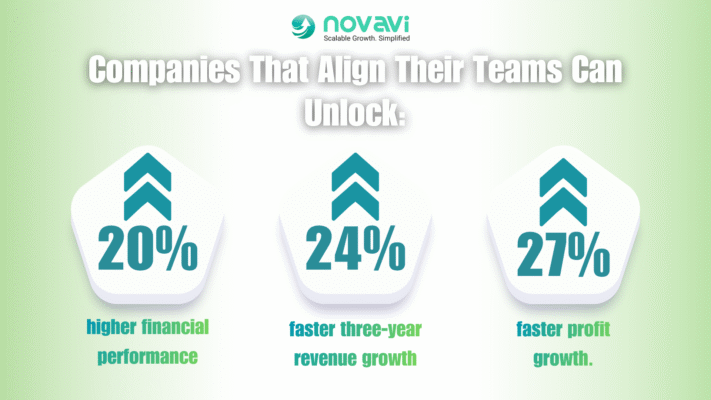
We saw this firsthand with a mid-market SaaS firm that struggled despite strong individual departments. Marketing, sales, and product were each running valid strategies, but not the same strategy. Once they unified their go-to-market model and agreed on one shared definition of a “qualified customer,” the shift was immediate. Campaigns reinforced product value, sales told a consistent story, and product prioritised features that actually drove expansion. Within two quarters, upsell revenue surged because the entire engine finally pulled in one direction — a clear example of performance alignment in action.
This kind of clarity directly fuels growth velocity. It allows teams to execute faster, deliver more consistent customer experiences, and support a value narrative that holds together from acquisition to renewal.
Because in the end, clarity isn’t about more meetings or heavier documentation — it’s about creating a shared operating rhythm that turns alignment into compounding success.
Aligning Messaging, Metrics, and Handoff Points
Once a team understands the cost of misalignment, the next step is putting the right structures in place. Three levers matter most: messaging, metrics, and handoff points. When these are aligned, scattered execution becomes coordinated progress — the foundation of strong team alignment.
Start with messaging. When marketing talks about “efficiency,” sales sells “simplicity,” and product builds for “power users,” customers hear three different stories. That inconsistency creates confusion, weakens brand credibility, and slows decisions. A shared message map ensures every touchpoint reinforces one value narrative.
Next are metrics. Teams often define success differently — MQLs for marketing, revenue for sales, adoption for product. Without unifying metrics like LTV, CAC, activation, and expansion, performance alignment is impossible. Shared scoreboards shift the focus from individual wins to collective outcomes and create true performance alignment across functions.
The final lever is handoff clarity. Misalignment usually appears in the transition moments: MQL → SQL, SQL → demo, trial → onboarding, onboarding → adoption. Without clear ownership and timing, leads stall and customers drop off early. This is where intentional team collaboration prevents leaks and accelerates momentum.
To bring these levers together, use the Message–Metric–Moment framework:
- Message — the story everyone tells.
- Metric — the outcomes everyone measures.
- Moment — the handoffs everyone follows.
When these three align, you create operational clarity that supports predictable execution — and sets the stage for scalable SaaS growth.
One Growth Language Across All Functions
Even the strongest playbooks fall apart when every team speaks a different language. That’s why the most scalable organisations adopt a unifying principle we call One Growth Language, a shared vocabulary supported by consistent feedback loops and aligned incentives that keep every function moving in the same direction. It becomes the operating system that turns ambition into execution and transforms team alignment from an occasional effort into a daily habit.
At its core, One Growth Language creates clarity across Brand, Marketing, and Sales. Imagine a simple model: three circles representing each function, connected by a shared centre labelled “Growth Language.” This visual reinforces a single foundation for decision-making — the same customer definitions, the same value narrative, the same pipeline expectations. When everyone speaks the same language, team collaboration becomes natural instead of forced.
One Growth Language isn’t just about consistency; it’s about acceleration. When teams use the same terminology, the same metrics, and the same expectations, miscommunication disappears and momentum compounds. According to Aberdeen Group, companies with strong marketing–sales alignment achieve 32% annual revenue growth, compared to a 7% decline for misaligned competitors. This creates true performance alignment and removes the friction that slows execution. It’s one of the simplest levers for unlocking scalable SaaS growth, because it ensures that every team is not just working hard, but working together toward the same outcome.
Where Growth Compounds
When teams shift from fragmented execution to a connected growth system, momentum finally becomes predictable. Misalignment fades, handoffs tighten, and decisions move faster. What begins as clearer messaging or unified metrics quickly turns into sustained SaaS growth — not just temporary wins. That’s the impact of real team alignment.
At Novavi, we’ve seen that the biggest breakthroughs don’t come from more tools or more effort. They come from creating one operating rhythm that unites brand, marketing, sales, and product. We don’t just help teams grow faster. We help them grow together.
If you’re ready to remove friction, increase growth velocity, and build the systems that support long-term SaaS growth, let us guide you. Start with a Growth Alignment Audit or explore the frameworks we use to turn clarity into compounding momentum.
Further Readings
Gilmore N (2022) How To Align Marketing And Sales Goals For Success
O’Neil S (2023) Sales and Marketing Alignment: Stats and Trends for 2023
Vanillasoft (2025) SALES & MARKETING ALIGNMENT: BRINGING THE PIECES TOGETHER
Dimuro M (2024) Empower Your Business With Cross-Functional Synergy: The Key To Resilience And Agile Growth
Donovan G (2025) Aligning Your Sales And Marketing Teams