
 Tiếng Việt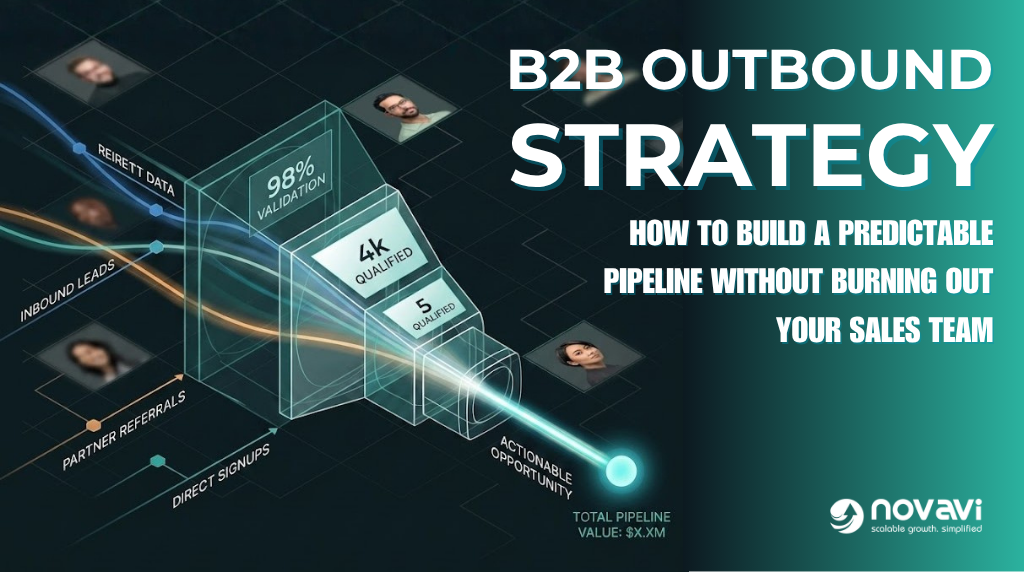
A busy sales team is not the same as a productive one. When outbound activity is high but the pipeline is unpredictable, the problem isn’t effort; it’s architecture.
A properly designed B2B outbound strategy isn’t built from tactics stacked on each other; it’s a structured system where each component serves the next. Without that architecture, more outreach produces more noise rather than more qualified conversations. And a team generating noise doesn’t just fail to produce pipeline, it burns out in the process.
Why B2B Outbound Strategy Breaks Even When Activity Is High
The most common symptom of a broken B2B outbound strategy is high activity with inconsistent results. The SDR is sending 80 emails a week, making 30 calls, connecting on LinkedIn daily , and the pipeline is still lumpy, still hard to forecast, still dependent on which account happens to be in-market that month.
The root cause is almost never the team. It’s the architecture beneath the team. Specifically, one or more of these three things is missing:
- ICP targeting that’s too broad , the list includes companies that could theoretically be a fit, not companies that are actively experiencing the pain your solution solves
- Unsequenced outreach , LinkedIn, email, and phone are deployed independently rather than as a coordinated multi-touch sequence that warms the prospect at each stage
- No feedback loop , response patterns (what’s working, what’s generating replies, what’s being ignored) aren’t reviewed and used to iterate messaging
Research from RAIN Group confirms that 80% of B2B sales require at least 5 follow-up touchpoints before a prospect responds. Most SDRs stop after two. The gap between where outreach stops and where prospects start responding is where most pipeline disappears.
The SDR burnout pattern follows directly: when outreach volume is high and conversion is low, the rational response is more outreach. More outreach with the same broken architecture produces the same results, but with more exhaustion. The solution isn’t effort , it’s system design.
The 4 Components of a Predictable B2B Outbound Strategy
A B2B outbound strategy that produces consistent SQLs is built from four components, each feeding the next. Remove one, and the system becomes unpredictable. Keep all four, and it compounds.
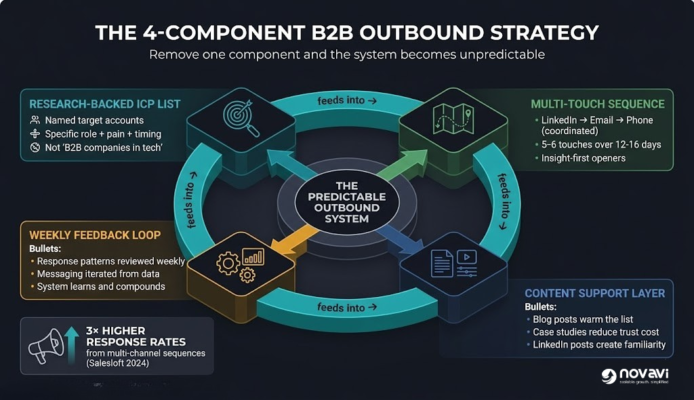
Component 1, Research-Backed ICP Target List
Not a job title and an industry. A specific definition that produces a list of companies you can name, along with the role, pain, context, and timing. Gartner research shows that the average B2B purchase now involves 6–10 decision-makers. A target list that reaches the wrong role in the right company never converts , because the person receiving outreach doesn’t have the authority or the pain to respond.
Component 2, Multi-Touch Sequenced Outreach
LinkedIn, email, and phone as a coordinated sequence, not three parallel channels. The logic: LinkedIn connection warms the prospect and establishes presence. Email follow-up carries the insight. Phone call to a warmed prospect (one who’s already seen your name twice) converts at a fundamentally higher rate than a cold call.
Salesloft’s 2024 sales engagement research found that multi-channel sequences produce 3× higher response rates than single-channel outreach. The channel isn’t the differentiator , the coordination across channels is.
Component 3, Content Support Layer
Blog posts, case studies, and LinkedIn content that warm the ICP before the first outreach sequence begins. A prospect who has encountered your content before receiving your email doesn’t experience that email as cold. They experience it as a logical continuation of something they’ve already engaged with.
Component 4, Weekly Feedback Loop
Response patterns are reviewed every week: which messages are generating replies, which subject lines are being opened, which segments are converting and which aren’t. Opinion rather than data are optimising a B2B outbound strategy without a feedback loop, and opinion is almost always wrong.
The Multi-Channel Model That Produces Consistent SQLs
Single-channel outreach misses buyers at different stages of their decision process. A prospect who doesn’t open emails might accept a LinkedIn connection. A prospect who ignored three emails might answer a phone call after seeing your name twice on LinkedIn. Channel diversity isn’t about volume; it’s about coverage across a buyer’s attention span.
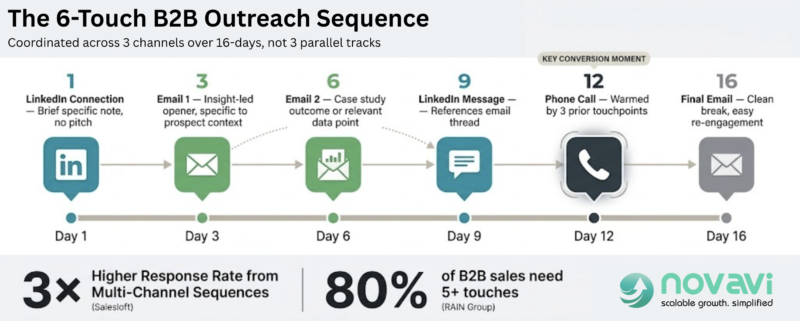
The sequence that produces consistent results across Novavi’s B2B outbound strategy campaigns:
- Day 1: LinkedIn connection request (with a brief, specific note, no pitch)
- Day 3: Email 1, insight-led opener referencing a specific challenge relevant to the prospect’s industry or role
- Day 6: Email 2, follow-up with a relevant case study outcome or specific data point
- Day 9: LinkedIn message, brief, referencing the email thread
- Day 12: Phone call, warmed by three prior touchpoints; opener references previous outreach
- Day 16: Final email, clean break with an easy re-engagement option
In Novavi’s APAC cybersecurity campaign, this structure, deployed consistently across a research-backed ICP list, produced 88 sales-qualified meetings over 14 months. Not because the outreach was clever, but because the system was consistent.
DATA POINT: The metric that separates a working B2B outbound strategy from one that only sometimes works is not SQL volume in any given week , it is SQL consistency across eight consecutive weeks. Spikes are luck. Consistency is system design.
How to Set Realistic Pipeline Targets Without Guessing
Most pipeline targets are set by working backwards from a revenue goal without accounting for the conversion rates that sit between outreach and closed revenue. The result: unrealistic expectations, missed targets, and an SDR team that feels like they’re failing even when they’re performing.
A more useful approach is to build a pipeline calculator from actual conversion benchmarks:
- Target: X SQLs per month
- SQL conversion from meetings booked: ~30–40% (industry average for well-targeted outreach)
- Meeting booking rate from responses: ~20–30%
- Response rate from sequences: ~5–15% (depending on ICP and personalisation quality)
- Working backwards: to produce 8 SQLs/month requires approximately 20–27 booked meetings, 80–130 responses, and 700–2,000 outreach touchpoints
These ratios improve as the system matures. A B2B outbound strategy in its first 30 days will convert at the lower end. By month 3, with a functioning feedback loop and iterated messaging, it should approach the upper end. This is why a 90-day measurement window is the minimum meaningful timeframe for evaluating any structured outbound system.
Forrester research confirms that companies with a formally documented sales process outperform by 18% in quota attainment , not because process is bureaucratic, but because it creates the measurement infrastructure needed to learn and iterate.
Signs Your B2B Outbound Strategy Is Working, and When to Scale
The earliest positive signal in a B2B outbound strategy is not SQL volume; it’s response pattern consistency. If the same message type is generating replies across different companies and different SDRs, the system is learning. That’s the signal to document and double down, not to change.
The right time to scale, adding SDR headcount, expanding the ICP list, or entering new markets, is when the system is producing consistent results at the current headcount. Scaling a broken system produces more broken results. Scaling a working one produces a compounding pipeline.
Three signals that the system is ready to scale:
- Consistent weekly SQLs regardless of which SDR is running the sequences
- Messaging is being refined by data from the feedback loop, not by opinion or guesswork
- The pipeline calculator’s conversion ratios are stable or improving across three consecutive months
NOVAVI PRINCIPLE: The most expensive mistake in B2B outbound is hiring more SDRs before the system they’re running is proven. Headcount amplifies whatever the system does , good or broken.
Is your outbound producing consistent SQLs or consistent activity?
Book a free 30-minute consultation with Novavi, and we’ll audit your current outbound system against the four components and show you exactly what’s producing inconsistency.