
 Tiếng Việt
The B2B buyer has changed. The channels are saturated, the inbox is noisier, and the trust threshold is higher. Founders still running 2023 playbooks in 2026 are competing on a field that no longer exists.
Understanding B2B sales trends 2026 isn’t just useful market intelligence — it’s the difference between compounding pipeline and diminishing returns on activity that used to work. The four shifts outlined below aren’t predictions. They’re already happening, they’re already reshaping B2B buyer behaviour 2026, and what matters now is whether your go-to-market motion has adapted to meet them.
B2B Sales Trends 2026: Why the Old Playbook Is Failing
Most founders built their sales approach during a period when buyer behaviour was more accessible. Outbound emails got opened. LinkedIn connection requests got accepted. Cold calls converted on fewer touches.
That environment has structurally changed. B2B sales trends 2026 reflect a buyer population that is more informed, more sceptical, more self-directed, and interacting with more content from more competitors than at any prior point. The strategies that worked in 2022–2024 require meaningful adaptation, not incremental optimisation — and any honest 2026 B2B sales playbook has to start with that recognition.
This isn’t a permanent pessimistic state. It’s a recalibration moment. The companies that understand the new B2B buyer behaviour 2026 environment and redesign their motion around it are not struggling — they’re compounding. The companies that haven’t adapted are the ones describing pipeline as ‘inconsistent’ and ‘harder than it used to be.’
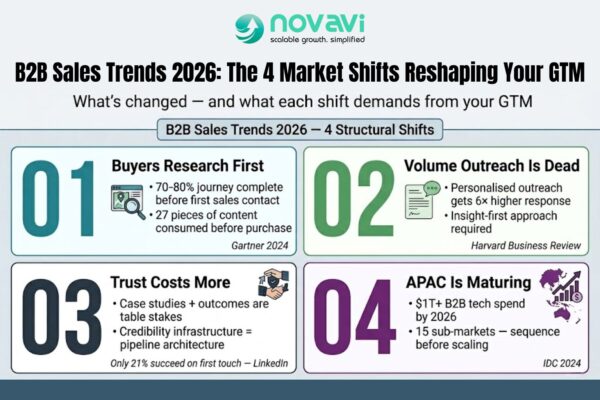
Below are the four structural shifts defining B2B sales trends 2026 — and the strategic response each one demands.
Shift 1 — Buyers Research Deeply Before They Ever Talk to Sales
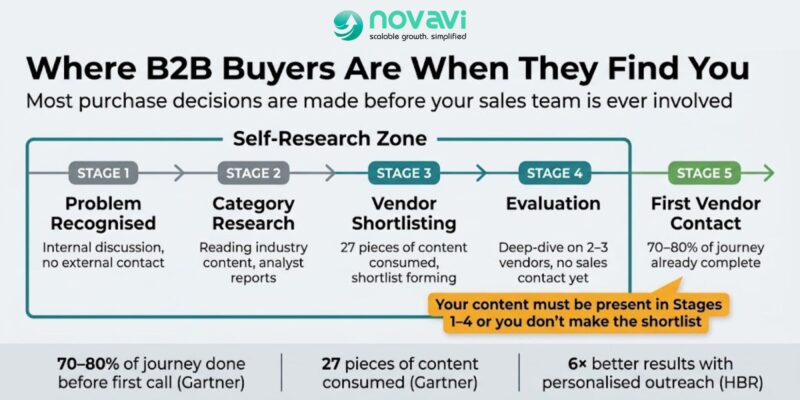
Of all the B2B sales trends 2026 reshaping pipeline, this one is the most foundational. Research from Gartner confirms that B2B buyers now complete 70–80% of their purchase journey before speaking to any vendor. They’re reading blog posts, reviewing case studies, watching product demos, and forming shortlists — all before your SDR sends the first message.
The same research from Gartner found that B2B buyers interact with an average of 27 pieces of content before making a purchase decision. Twenty-seven. That’s not a buying process your sales team can interrupt with a cold call — it’s a research journey your content needs to be part of, and it’s the single biggest change driving B2B buyer behaviour in 2026.
The implication for founders is direct: your content must do trust-building work before sales ever gets involved. Authority content — blog posts, case studies, LinkedIn insight, email sequences — is not a marketing nice-to-have. It’s the first half of every sales conversation, happening without you in the room.
Shift 2 — Cold Outreach Still Works, But Volume Kills Credibility
If you’ve been wondering why cold outreach is declining across nearly every B2B segment, the answer isn’t a mystery — mass sequencing has conditioned B2B buyers to filter templated outreach on sight. The open rate decline is real. The response rate decline is real. But the cause isn’t that cold outreach is dead — it’s that volume-based, undifferentiated outreach is dead, and that distinction sits at the centre of any credible outbound sales strategy 2026.
Harvard Business Review research shows that personalised, insight-led outreach achieves 6× higher response rates than templated sequences. The difference isn’t personalisation for its own sake — it’s outreach that demonstrates you understand the recipient’s specific context, challenge, or recent activity before asking for anything. This is the core of the new outbound sales strategy 2026 that high-performing teams are operating on.
The Novavi model — insight first, ask second — reflects this shift directly. An outreach sequence that leads with a relevant observation about the prospect’s market, product gap, or recent announcement converts at fundamentally higher rates than one that leads with ‘I wanted to reach out about…’
A practical example: when Novavi pivoted a UK IT firm’s outreach toward cybersecurity-specific messaging — tailored to each prospect’s industry exposure — it unlocked 44 meetings that a generic technology pitch had not. Same product. Different insight in the opening. Completely different results. That’s why cold outreach is declining as a volume game while accelerating as an insight game.
Shift 3 — Trust Has a Higher Entry Cost Than Two Years Ago
Among the B2B sales trends 2026, founders most often underestimate, the rising trust threshold is at the top. Buyers now require more proof before entertaining a conversation than they did in 2022 or 2023. Case studies, specific outcome data, and named client results are no longer differentiators — they’re table stakes. A website without a single case study that names an outcome is a trust liability, not a neutral position.
Social proof has moved from a conversion tool to a prerequisite. LinkedIn’s State of Sales research shows that only 21% of B2B sales reps make successful contact on the first outreach attempt. The other 79% require repeated touches — and those touches need a credibility layer (your LinkedIn profile, website, published content) to warm the prospect between contacts. Any serious outbound sales strategy 2026 has to budget for that credibility layer up front.
The strategic response: treat your credibility infrastructure — website, case studies, LinkedIn presence, published insight — as pipeline architecture, not brand maintenance. Every piece of proof you publish reduces the trust cost of every sales conversation that follows.
Shift 4 — APAC and Emerging Markets Are Maturing Fast
Among B2B sales trends 2026, the APAC dynamic is one of the most significant and underutilised opportunities for B2B tech companies. IDC data shows that APAC B2B technology spending is growing at 8.4% CAGR and will exceed $1 trillion by 2026 — the fastest growth rate of any global region.
But APAC is not a single market. Singapore and Australia move at Western buying speed — decision cycles of 30–60 days, English-first communication, and a comfort with self-directed research. Vietnam, Indonesia, and the Philippines require longer nurture cycles, education-led engagement, and localised proof of relevance before outreach converts. The B2B buyer behaviour 2026 picture in Jakarta is fundamentally different from the one in Sydney, and the playbook has to reflect that.
Companies that enter APAC, treating it as one homogeneous market, burn budget in months. Companies that sequence by market, validating one Tier 1 market before expanding, build a compounding pipeline across the region. This distinction is one of the defining strategic differences between B2B companies that grow in APAC and those that retreat from it.
McKinsey’s research on Southeast Asia confirms that omnichannel B2B companies achieve 10% higher revenue growth than single-channel competitors, a finding that is particularly acute in fragmented markets like APAC, where buyers are spread across multiple platforms and buying modes.
What Founders Should Do Right Now
The four shifts above converge on the same strategic response: invest upstream before scaling execution.
- Audit your content layer: how many of your ICP’s research questions does your published content answer? If fewer than half, your pipeline is being lost before sales is ever involved.
- Personalise before you sequence: review your outbound messaging. Does each sequence lead with a specific insight relevant to the prospect’s context? If the first email could have been sent to any company in your list, it will convert like it was sent to no one.
- Build your trust infrastructure: publish a minimum of three named case studies with specific outcomes before scaling outbound. Every missing case study is a trust gap that your SDR is trying to close in a 15-minute call.
If you’re targeting APAC — sequence before scaling: validate one Tier 1 market (Singapore, Australia) with a focused 90-day campaign before expanding. Data from one market funds the strategy for the next.
The B2B sales trends 2026 environment is not harder for everyone. It is harder for companies whose go-to-market hasn’t adapted. For those who have — or who adapt now — the reduced competition at the top of each buyer’s shortlist is a significant structural advantage.
NOVAVI VIEW: Every company that still treats B2B buying as a volume game is clearing the field for those who have shifted to an insight-led, trust-first approach. That’s not a threat — it’s the clearest competitive opening available in 2026.
Is your go-to-market motion built for 2026 or 2023?
Book a free 30-minute strategy session with Novavi — we’ll audit your current sales motion against the four shifts above and show you exactly where to adapt.