
 Tiếng Việt
You’ve spent years mastering your craft. Your clients get results. Your referrals are warm. But outside your immediate network, nobody knows you exist, and that gap is costing you pipeline every single month.
What most B2B founders discover too late is that B2B thought leadership for founders isn’t a marketing luxury; it’s the infrastructure on which every pipeline mechanism compounds. Without it, every outbound sequence starts from zero. With it, buyers already know your thinking before your SDR sends the first email.
What the Founder Authority Gap Actually Is
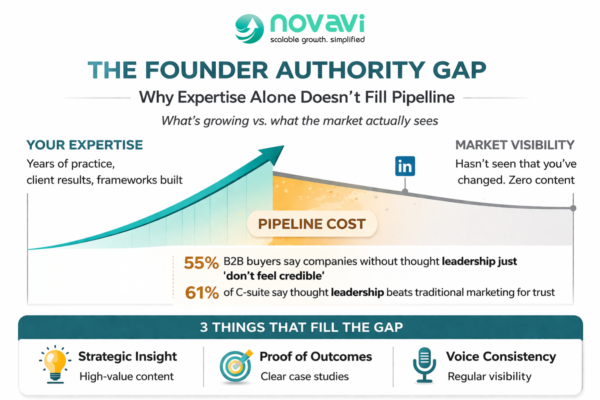
The authority gap is the distance between what you know and what the market perceives you to know. For most B2B founders, that gap is significant, and it widens quietly over time.
Here is why it widens: expertise deepens with every client engagement, every solved problem, every market entered. But the brand remains static. The LinkedIn profile was last updated two years ago, the website copy written before the last product pivot, and the one conference talk that never got a follow-up article. Expertise grows. Visibility doesn’t.
The clearest signal that the authority gap is costing you pipeline: you win almost every time you get in the room. Your close rate is strong, your proposals land well, and your referrals are warm. The problem isn’t converting; it’s that getting in the room requires active effort every single time, and it doesn’t happen without it.
Authority is not credentials. Credentials say you’re qualified. Authority says you understand the problem before being asked. It’s built through consistent, visible strategic thinking, not through a logo wall on your website or a list of clients you’re not allowed to name publicly.
Why Technical Expertise Alone Doesn’t Build B2B Trust
B2B buyers don’t evaluate expertise first. They evaluate risk. The question they’re asking before ‘are you good at this?’ is ‘will working with you create problems we don’t currently have?’ Expertise that’s invisible offers no reassurance on that question.
Trust is built through pattern recognition, and that pattern requires repeated signals over time. A buyer who has read three of your blog posts before your first conversation has already begun forming a view of how you think, what you prioritise, and whether your approach fits their context. That’s not marketing. That’s the foundation of a trust relationship.
According to the 2024 Edelman-LinkedIn B2B Thought Leadership Impact Study, 55% of B2B decision-makers use thought leadership to vet organisations, even when not actively in-market. They are reading, forming views, and building shortlists long before a conversation happens. If you’re not producing that content, you’re not on the shortlist.
The same research found that 61% of C-suite executives consider thought leadership more trustworthy than traditional marketing or advertising, not case studies with logos, not award badges, not paid media. Consistent strategic insight, published in the open, is the highest-trust content format available to a B2B founder.
B2B Thought Leadership for Founders: The 3-Pillar System
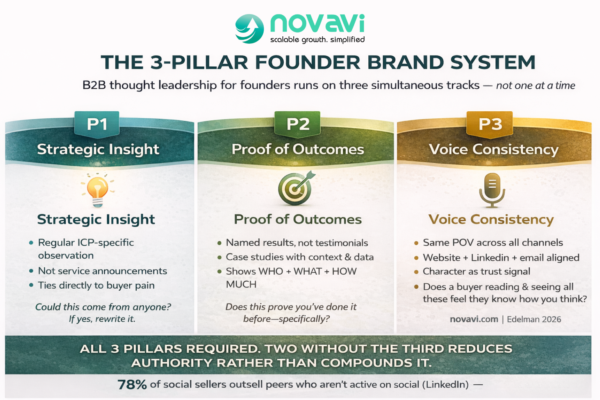
Effective B2B thought leadership for founders is not a social media strategy. It’s an integrated system with three interdependent layers that must run simultaneously to compound.
Pillar 1: Consistent Strategic Insight
Not service announcements. Not industry news you’ve reposted. Not generic productivity tips that could have come from anyone. The specific, considered view you hold on the problems your ICP is trying to solve right now, published on a cadence your audience can anticipate.
A useful filter: could this content have been written by a content agency with no knowledge of your clients? If yes, it’s commodity content. Commodity content generates traffic. It does not build authority.
Pillar 2: Proof of Outcomes
Buyers need to see not just that you understand the problem, but that you’ve solved it for people like them. Case studies, outcome data, and client result stories form the evidence layer beneath the insight layer. Without it, strategic insight is opinion. With it, it becomes a pattern of proof.
Pillar 3: Voice Consistency
The same strategic POV must exist across every touchpoint: website positioning, LinkedIn posts, blog content, outreach emails. When a buyer encounters you in three different contexts and hears the same coherent voice, it registers as character, the most powerful trust signal available.
LinkedIn research shows that 78% of social sellers outsell B2B peers who aren’t active on social channels, not because social media is magic, but because consistent presence builds the pattern recognition that precedes trust.
How to Close the Gap Without 10 Hours a Week on Content
The most common reason B2B founders don’t build their brand is time. The second is not knowing where to start. Both are solvable with the right system.
The content trap is real: volume without strategic direction doesn’t build authority. Posting every day about topics unrelated to your ICP’s specific problems is noise, not signal. Three well-positioned pieces of B2B thought leadership for founders per week build more authority than 20 generic ones.
The most efficient framework: one strategic insight per week, written as a short observation tied to a specific ICP pain. That insight becomes a LinkedIn post on Monday, a paragraph in a nurture email on Wednesday, and a blog intro next month. One insight. Three channels. Roughly 40 minutes of original writing.
Research from the Demand Gen Report confirms that 71% of B2B buyers consumed three or more pieces of content before making a purchase decision. They are forming a view over weeks and months, not in a single visit. Cadence matters more than any individual piece.
What Authority-Led Pipeline Looks Like in Practice
When B2B thought leadership for founders is working, the sales process changes structurally, not just in feel.
The first signal is inbound consultation requests that reference specific content. “I read your post on ICP clarity and it described exactly where we’re stuck” is not a warm lead. It is a pre-qualified conversation that starts three steps further along the trust curve than any cold outreach could achieve.
The Novavi experience with Cypro illustrates this directly. Before building the pipeline system, three months were invested in founder positioning: the website POV was restructured, LinkedIn was rebuilt around consistent GTM insight, and case studies were written in outcome language rather than testimonial format. By the time outreach began, the founder’s name was already familiar to the target segment, and conversion rates reflected it.
According to the Content Marketing Institute, 96% of B2B buyers want thought leadership that provides more specific, actionable industry insight. The bar is not low. Generic insight does not convert. Specific, ICP-relevant strategic thinking, published consistently, does.
Ready to turn your expertise into a brand that generates a pipeline?
Book a free 30-minute Founder Brand Audit with Novavi: we’ll map exactly where your authority gap is and what it’s costing you each month.