
 Tiếng Việt
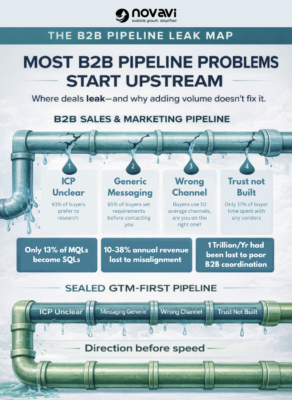
Most B2B SaaS companies treat the pipeline as a numbers game. Add more outreach, hire another SDR, run another ad campaign. But the pipeline doesn’t compound — it leaks. And the leak is always upstream.
In most cases, the root issue is a B2B SaaS go-to-market strategy assembled after execution had already begun — and a pipeline that reflects the gaps left behind.
The Pipeline Myth: Why More Activity Rarely Means More Revenue
Here is a pattern that repeats across B2B SaaS companies of all sizes and stages: activity goes up, but revenue predictability stays flat.
More outreach. More meetings booked. More leads are entering the top of the funnel. And yet, close rates remain inconsistent. Early-stage deals churn. The pipeline that looked healthy in Week 2 is half-empty by Week 6.
The instinctive response is to add more volume. But research from Gartner shows that B2B buyers now spend only 17% of their total buying journey in direct contact with any vendor. When evaluating multiple providers, that figure drops to just 5 or 6% for each. The implication is clear: the problem isn’t that you need to be in more conversations. It’s that you need to be the right answer when buyers are doing their own research, which is most of the time.
The root cause of an unpredictable pipeline is rarely a lack of activity. It’s a lack of clarity — deployed before the activity began.
When tactics are launched before GTM clarity is established, every SDR is effectively selling to whoever they can reach rather than whoever they should. Every piece of content addresses a general audience rather than a specific pain point. Every follow-up email restarts the trust conversation from zero.
The result: high activity, low conversion, and deals that either stall or close with customers who churn early because they were never the right fit to begin with. Research consistently links poor ICP fit to elevated B2B SaaS churn rates — a cost that compounds long after the sale.
Only 13% of MQLs convert to SQLs on average in B2B SaaS funnels. When ICP targeting is unclear, that number drops further, because more of the funnel is filled with the wrong people.
We saw this pattern directly with a Melbourne-based Health, Safety, and Compliance SaaS company that partnered with Novavi. They had strong technology across three product lines — but no structured APAC pipeline. Before deploying a single outreach sequence, we worked upstream: defining the ICP by product, by region, and by decision-maker role. The 67 SQL statements that followed weren’t the result of increased activity. They were the result of better direction first.
What a GTM-First B2B SaaS Go-to-Market Strategy Actually Looks Like
Go-to-market is not a marketing plan. It’s not a sales playbook. It’s the foundational set of decisions that determines who you’re for, what you’re saying, and how you’re reaching them — made deliberately, before scaling any of the above.
A genuine B2B SaaS go-to-market strategy runs in a specific sequence:
ICP → Positioning → Messaging → Channel → Execution
Each step informs the one that follows it. Skip a step, and the subsequent steps will produce inconsistent results regardless of how well they’re executed.
Most B2B SaaS companies do the reverse. They start with execution — because execution feels productive — and attempt to define strategy on the way. This is why so many founding teams describe their pipeline as “unpredictable.” It is unpredictable, because its foundations were built after the building had already started.
A 2024 report from 6sense found that 85% of B2B buyers establish their purchase requirements before contacting any vendor. That means by the time a buyer enters your pipeline, they have already formed a view of the problem, the solution category, and potentially a shortlist of vendors worth talking to. If your positioning is unclear, you’re not entering the pipeline — you’re being filtered out before the first conversation.
Strategy → Marketing → Sales is a sequence, not three parallel tracks. Research from Forrester and the former SiriusDecisions division confirms this: companies with aligned sales and marketing functions achieve 24% faster three-year revenue growth and 27% faster profit growth compared to misaligned organisations. That alignment starts with GTM clarity — not with a sales-marketing sync meeting.
The 3 GTM Clarity Decisions Every Founder Must Make First
Before executing any B2B SaaS go-to-market strategy — the first SDR send, the first piece of content, the first advertising dollar — three decisions must be made with specific, written clarity.
1. ICP Clarity: which companies, which roles, which pains — specifically
Not “B2B SaaS companies.” Not “marketing leaders.” Specific industries, specific employee ranges, specific geographies, specific decision-maker roles, and — most critically — the specific problem they are actively trying to solve right now.
A useful test: can your SDR build a list of 200 exact-fit target accounts from your ICP definition? If the answer is no, the ICP is not yet specific enough to run outreach
2. Positioning Clarity: what makes you different from a buyer’s perspective
Not from your perspective — from theirs. Positioning is not your list of features. It’s the one sentence a prospective buyer would use to explain why you’re different to a colleague. If constructing that sentence requires reading your entire website, your positioning isn’t working.
3. Channel Clarity: where your ICP actually spends decision-making time
LinkedIn and cold email remain the most effective B2B outbound channels in most segments, but the optimal mix depends on your ICP’s actual behaviour. McKinsey’s B2B Pulse research found that B2B buyers today use an average of ten different interaction channels across the purchase journey. Channel selection is less about picking one and more about sequencing intelligently across multiple touchpoints.
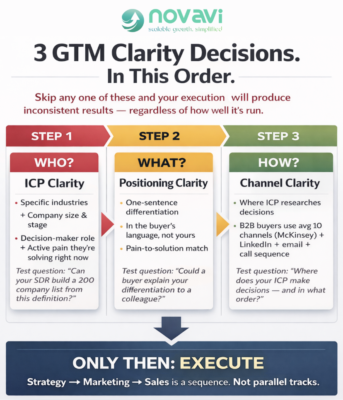
These three decisions are not a strategic luxury. They are the infrastructure on which every campaign, every SDR hire, and every content investment will run. Without them, you’re scaling on sand.
What a GTM-First Pipeline Looks Like in Practice
The clearest way to understand what a well-structured B2B SaaS go-to-market strategy produces is to look at what happens when it’s applied before execution begins.
When Novavi partnered with a London-based cybersecurity company to build an APAC pipeline, we didn’t start with outreach. We started upstream: defining the ICP specifically — financial institutions, banks, and enterprises in markets with the highest cybersecurity demand — then identifying the decision-maker roles — CISOs, CTOs, CIOs — and building the outreach sequence, LinkedIn content, and email nurture to serve that exact audience.
The result over 14 months:
- 88 sales-qualified meetings booked
- 52 prospects progressed to two-week product trials
- 4 closed deals
- A repeatable, measurable system that produced consistent KPIs across geographies
This is what a GTM-first pipeline looks like in practice: an integrated multi-channel approach (LinkedIn, email sequences, cold calls to warmed leads, and content that educates the ICP before the first conversation), running within a structured 90-day traction window where the first 30 days establish ICP and messaging, the next 30 begin systematic outreach, and by Day 90, response patterns allow for intelligent iteration.
The metric that separates a GTM-first pipeline from a tactics-first one is not volume, it is conversion consistency. When ICP, positioning, and channel are correct, conversion rates don’t spike and crash. They improve steadily as the system learns.
Why Founders Keep Skipping This Step, and the Cost
The honest answer is that GTM clarity feels like a delay. Execution feels like progress. Writing an ICP document, pressure-testing a positioning statement, and mapping channel decisions to specific buyer behaviours requires time and strategic discipline — and neither produces a meeting next Tuesday.
But the cost of skipping it is high and compounding.
Studies show that B2B companies lose between 10% and 38% of annual revenue to sales and marketing misalignment, a condition that almost always originates in the absence of a clear B2B SaaS go-to-market strategy upstream. Across the broader B2B economy, an estimated $1 trillion per year is lost in the US alone due to poor sales and marketing coordination.
Beyond the revenue cost is the opportunity cost: the months spent refining outreach that was reaching the wrong buyers, the SDR capacity consumed by conversations that were never going to close, and the content produced for an audience that didn’t match the ICP. These costs are invisible — they show up as “pipeline looks strong but close rate is low” or “we’re getting meetings but they’re taking forever to convert.”
According to Gartner’s 2025 research, 61% of B2B buyers now prefer a completely rep-free buying experience for at least some purchases. In a market where buyers are increasingly making decisions before speaking to anyone, the question isn’t whether you have enough outreach. It’s whether your positioning is clear enough to make it onto the shortlist before it closes.
NOVAVI PRINCIPLE: GTM clarity before amplification is the core principle behind every campaign Novavi runs. Not because it’s theoretically elegant, but because every time a client has launched without it, the pipeline leak has been the same. And every time we’ve established it first, the pipeline has compounded.
Ready to build a pipeline that doesn’t leak?
Book a free 30-minute consultation with Novavi, and we’ll map your current GTM against the three clarity decisions, and show you exactly where the leak is.