
 Tiếng Việt
Founders are natural visionaries. They see possibilities before others do. They connect patterns early. They imagine what the company could become long before it gets there.
But there is a hidden risk that comes with this strength.
When every message stays at the big-picture level, teams struggle to translate ambition into action. Without strong strategic communication, even the clearest vision can start to feel like noise inside the organization.
The real challenge most founders face is not vision. It is strategic clarity, the ability to communicate direction in a way that creates execution, not just inspiration.
Because companies rarely fail from lack of ideas. They stall when ideas outpace alignment.
And alignment does not come from more talking. It comes from better communication systems that create organizational alignment and sustained strategic focus.
The Clarity Gap: When Ideas Outpace Execution
Most founders communicate frequently. But frequency is not the same as effectiveness.
What we often see is this pattern: New ideas are shared weekly → Priorities evolve constantly → Opportunities are discussed openly.
This feels like momentum. But without disciplined strategic communication, it often produces the opposite effect: execution slows while conversations increase. Even high-performing companies have a 30% gap between their strategy’s full potential and what is actually delivered. This creates what we call the clarity gap.
A clarity gap appears when leaders speak in vision, while teams work through tasks. Without strategic clarity, it becomes hard to tell what is urgent, what is important, what is exploratory, and what is the actual direction. Everything starts to feel equally important, which usually means nothing truly is.
That is when execution begins to fragment. The problem is often not team capability, but a lack of strategic focus in communication. Execution improves when communication narrows priorities instead of expanding possibilities. Strong operators do not just explain what could happen. They make clear what matters now.
Why Teams Stop Listening: Vision Fatigue and Lost Organizational Alignment
When leaders constantly introduce new directions without reinforcing priorities, something subtle happens.
Teams do not push back. They do not resist. They simply start filtering. This is vision fatigue.
Vision fatigue occurs when communication becomes abstract, repetitive, or constantly shifting. Over time, messages stop driving action because they stop creating organizational alignment. This is not a motivation issue. It is a strategic communication issue.
Only 46% of employees clearly know what is expected of them at work, and 15% of employees fully grasp the rationale behind their organization’s strategy. When teams cannot see how today’s priorities connect to yesterday’s message, trust in direction weakens. Not trust in leadership, trust in direction, and direction is what execution depends on.
Without consistent messaging, even high-performing organizations can lose organizational alignment. Departments optimize locally. Priorities compete instead of reinforcing each other. Effort increases while impact plateaus.
This is why the most effective founders communicate less variation, not more information.
The Language of Focus: Turning Vision Into Strategic Clarity
While 69% of employees say their organization has a clear strategy, only 59% of non-leaders agree, compared with 74% of leaders. Vision may inspire, but clarity is what gives teams direction. The companies that scale well are not always the most ambitious, but the ones whose leaders turn vision into action through disciplined strategic communication.
That means translating big ideas into clear priorities, decisions, and next steps. Strong founders simplify execution by making it obvious what matters now, what success looks like, and what teams can ignore. In this way, strategic clarity becomes a leadership capability, not a personality trait.
When communication creates real focus, decisions happen faster, meetings become shorter, ownership grows, and execution improves over time. Strategic focus does not come from pressure. It comes from clarity.
Framework: Define → Distill → Direct
Founders often try to improve communication by speaking more. The real leverage comes from structuring communication differently.
At Novavi, we often help founders think about communication as a system rather than a leadership activity.
A simple framework we often apply is:
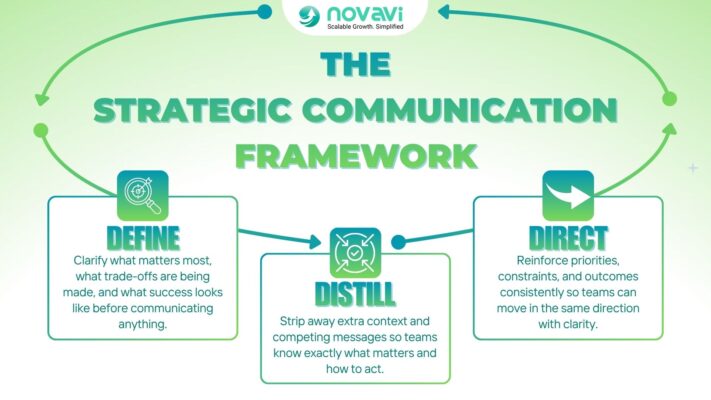
Define: Create strategic clarity
Distill: Communicate what matters
Distillation is where strategic communication becomes powerful. Most leaders share everything they know, but effective leaders share what teams need to act. It removes unnecessary context, unclear possibilities, and competing directions. This does not reduce transparency. It improves usefulness. Teams do not execute better because they know more. They execute better because they know what matters.
Direct: Create organizational alignment
Communication must ultimately create movement. Understanding alone is not enough. Execution requires organizational alignment, where teams move in the same direction without constant correction. That happens when communication consistently reinforces priorities, constraints, and expected outcomes. This is where strategic communication becomes operational infrastructure rather than leadership style. Companies that scale well rarely depend on charismatic messaging. They depend on repeatable clarity.
Communicating Strategy as a System, Not a Speech
One of the biggest transitions founders must make as companies grow is shifting communication from personality-driven to system-driven. Redesigning the operating model can drive 5x–10x faster decision-making and change, alongside broader performance gains. Early companies often rely on founder energy, but scaling companies rely on communication infrastructure. Strategy should not depend on how inspiring the last town hall sounded. It should depend on whether teams can consistently turn direction into execution.
Sustainable execution comes from structured strategic communication, not occasional motivational messaging. The companies that maintain momentum treat communication like product development or revenue operations: as a system that requires design. Because communication is not just about how strategy is explained. It is how strategy is implemented.
When communication systems improve, decision quality, execution speed, cross-team coordination, and organizational alignment become more stable. This is why growth problems are often communication problems in disguise.
From Vision to Strategic Focus
Vision will always be the founder’s advantage, but clarity is what allows organizations to scale that advantage. The founders who build durable companies are not the ones with the most ideas. They are the ones who master strategic communication, turning ideas into direction, direction into strategic focus, and focus into execution.
This is how companies move from ambition to organizational alignment, from activity to outcomes, and from noise to strategic clarity. Growth rarely breaks from lack of effort. It breaks when effort spreads across too many directions. The role of leadership is not to create more energy, but to create direction that energy can follow.
A practical reflection for founders
If your strategy feels clear to you but execution feels inconsistent, the gap is rarely capability. It is usually a communication structure.
Ask yourself:
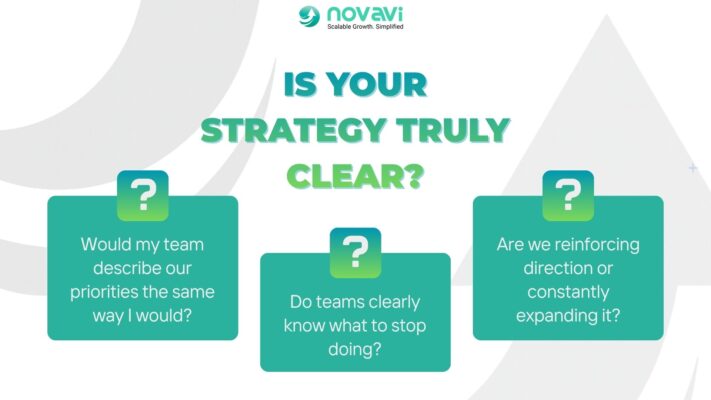
If these answers feel uncertain, the opportunity is not better execution discipline. It is stronger strategic clarity through better communication design.
Turning vision into execution
At Novavi, we work with founders who do not lack ambition or strategy. What they need is a clearer way to turn vision into action through strategic communication that builds strategic clarity, strengthens organizational alignment, and maintains strategic focus as they scale.
Strategy rarely fails because the vision is wrong. It fails when that vision is not translated into execution. If your strategy feels clear in your head but harder to operationalize across teams, the next stage of growth may not require a new strategy, just a clearer one.
Book your free 30-minute consultation to turn vision into clarity your team can align around.
Further Readings:
McKinsey Quarterly (2025) A new operating model for a new world
Murphy M (2025) Why Employees Aren’t Committing To Your Company’s Strategy
Harter J (2025) U.S. Employee Engagement Sinks to 10-Year Low
Pontefract D (2024) What Leaders Get Wrong About Strategy